
When I focused on God’s law as the primary revelation of his will, justice and mercy seemed like oppositional concepts. Justice meant the uniform application of law (punishment mainly) and mercy was an exception to that uniform application. As justice increased mercy decreased. As mercy increased justice decreased (Fig. 1).
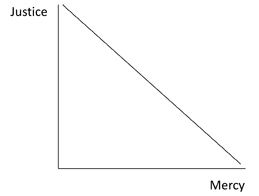
Fig. 1
Justice served as a limit on mercy as mercy limited justice. So the righteousness of justice and mercy was a mean between these extremes, because justice was by definition unmerciful, at least in part, and mercy was by definition unjust, at least in part. This made perfect sense to my religious mind, until I read the Bible.
Woe to you, experts in the law and you Pharisees, hypocrites, Jesus said. You give a tenth of mint, dill, and cumin, yet you neglect what is more important in the law – justice (κρίσιν, a form of κρίσις), mercy1 (ἔλεος), and faithfulness (πίστιν, a form of πίστις)! You should have done these things without neglecting the others.2 Love was added to this list in Luke’s Gospel account: But3 woe to you Pharisees! You give a tenth of your mint, rue, and every herb, yet4 you neglect5 justice (κρίσιν) and love (ἀγάπην, a form of ἀγάπη) for God!6
How could mercy be both an exception to the uniform application of law and, along with justice and faithfulness, more important in the law than tithing mint, dill and cumin? Jesus, it seemed, considered mercy part of the justice of the law rather than a limit upon it. Go and learn what this saying means, He said, quoting Hosea, “I want mercy (ἔλεος) and not sacrifice.” For I did not come to call the righteous, but sinners.7
|
# |
Jesus (NET) |
Blue Letter Bible (Septuagint) |
NET Bible (Greek parallel text) |
|
1 |
I want mercy and not sacrifice
Matthew 9:13 (NET) |
ἔλεος θέλω καὶ οὐ θυσίαν | ἔλεος θέλω καὶ οὐ θυσίαν |
Why does your teacher eat with tax collectors and sinners?8 the Pharisees had asked, revealing their concern over the possibility of defilement.9 When Jesus heard this he said, “Those who are healthy don’t need a physician, but those who are sick do,”10 revealing his concern for the mercy that was an important part of the law. On another occasion Jesus went even further and told the Pharisees, If you had known what this means: “I want mercy (ἔλεος) and not sacrifice,” you would not have condemned the innocent.11 Jesus’ disciples had been gathering grain and eating the grain they had gathered on the Sabbath day. It was about as direct a violation12 of the law of the Sabbath as I can imagine, but Jesus declared them innocent, adding that the Pharisees and I would agree with Him if we understood the mercy that was an important part of the law.
Teacher, what must I do to inherit eternal life?13 an expert in religious law asked Jesus (Luke 10:26-28 NET).
He said to him, “What is written in the law? How do you understand it?” The expert answered, “Love (ἀγαπήσεις, a form of ἀγαπάω) the Lord your God with all your heart, with all your soul, with all your strength, and with all your mind, and love your neighbor as yourself.” Jesus said to him, “You have answered correctly; do this, and you will live.”
The law expert asked for clarification of the term neighbor. Jesus told a story: A man…fell into the hands of robbers, who stripped him, beat him up, and went off, leaving him half dead.14 Two other men passed the robbers’ victim by, but one man felt compassion for him. He went up to him and bandaged his wounds, pouring oil and wine on them. Then he put him on his own animal, brought him to an inn, and took care of him. The next day.15 he took out two silver coins and gave them to the innkeeper, saying,16 “Take care of him, and whatever else you spend, I will repay you when I come back this way.”17
Jesus asked, “Which18 of these three do you think became a neighbor to the man who fell into the hands of the robbers?” The expert in religious law said, “The one who showed mercy (ἔλεος) to him.” So19 Jesus said to him, “Go and do the same.”20 So mercy shown to a stranger defined the term neighbor, and became the justice of the law of loving God and one’s neighbor. Beyond that this was the Gospel message in answer to the question, what must I do to inherit eternal life? Clearly my religious mind was in error.
When Matthew quoted Isaiah his primary focus was on Jesus’ fulfillment of the part of the prophecy that read, He will not quarrel or cry out, nor will anyone hear his voice in the streets.21 Though, Great crowds followed [Jesus], and he healed them all…he sternly warned them not to make him known.22 I am more interested here in the rest of the prophecy: Here is my servant whom I have chosen, the one I love, in whom I take great delight. I will put my Spirit on him, and he will proclaim justice (κρίσιν) to the nations.23 He will not break a bruised reed or extinguish a smoldering wick, until he brings justice (κρίσιν) to victory.24 As I began to recognize Jesus as the primary revelation of God’s will my understanding of justice and mercy began to change.
Justice and mercy are not in opposition but joined like a category I could only call justice-mercy (Fig. 2).
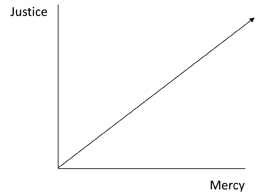
Fig. 2
Though justice-mercy may not actually be infinite in its capacity to increase, it is virtually infinite relative to my naive understanding. Probably it should be thought of as justice-mercy-faithfulness-love. But I’m not clever enough to represent that concept graphically.
Addendum (6/24/2015): Jim Searcy has published that the Septuagint is a hoax written by Origen and Eusebius 200 hundred years after Christ. “In fact, the Septuagint ‘quotes’ from the New Testament and not vice versa…” His contention is that the “King James Version is the infallible Word of God.” So, I’ll re-examine the quotations above with the KJV.
|
# |
Jesus (KJV) |
KJV |
NET Bible (Greek parallel text) |
|
1 |
I will have mercy, and not sacrifice | I desired mercy, and not sacrifice | ἔλεος θέλω καὶ οὐ θυσίαν |
The KJV will have and desired, though different tenses, are admittedly closer than the NET: For I delight in faithfulness, not simply in sacrifice (Hosea 6:6a NET) and, I want mercy and not sacrifice (Matthew 9:13 NET). If the present tense delight is incorrect relative to the past tense desired in Hebrew, this could be the first evidence I’ve discovered that the Septuagint quoted the New Testament.
The ASV, NKJV and NIV have desire (present), the DNT has delight (present), the GWT and TEV have want (present), TSMG am after (present), and YLT desired (past). Young’s Literal Translation (YLT) carries some weight with me, but I don’t know any Hebrew to decide this for myself.
Addendum: July 9, 2025
According to a note (93) in the NET the expert in religious law quoted from Deuteronomy 6:5 in Luke 10:27. The following table compares the Greek of that quotation with that of the Septuagint.
|
Luke 10:27b (NET Parallel Greek) |
Deuteronomy 6:5 (Septuagint BLB) Table |
Deuteronomy 6:5 (Septuagint Elpenor) |
| ἀγαπήσεις κύριον τὸν θεόν σου ἐξ ὅλης [τῆς] καρδίας σου καὶ ἐν ὅλῃ τῇ ψυχῇ σου καὶ ἐν ὅλῃ τῇ ἰσχύϊ σου καὶ ἐν ὅλῃ τῇ διανοίᾳ σου | καὶ ἀγαπήσεις κύριον τὸν θεόν σου ἐξ ὅλης τῆς καρδίας σου καὶ ἐξ ὅλης τῆς ψυχῆς σου καὶ ἐξ ὅλης τῆς δυνάμεώς σου | καὶ ἀγαπήσεις Κύριον τὸν Θεόν σου ἐξ ὅλης τῆς καρδίας σου καὶ ἐξ ὅλης τῆς ψυχῆς σου καὶ ἐξ ὅλης τῆς δυνάμεώς σου |
|
Luke 10:27b (NET) |
Deuteronomy 6:5 (NETS) |
Deuteronomy 6:5 (English Elpenor) |
| Love the Lord your God with all your heart, with all your soul, with all your strength, and with all your mind, | And you shall love the Lord your God with the whole of your mind and with the whole of your soul and with the whole of your power. | And thou shalt love the Lord thy God with all thy mind, and with all thy soul, and all thy strength. |
According to a note (94) in the NET the expert in religious law quoted from Leviticus 19:18 in Luke 10:27. The following table compares the Greek of that quotation with that of the Septuagint.
|
Luke 10:27c (NET Parallel Greek) |
Leviticus 19:18b (Septuagint BLB) Table |
Leviticus 19:18b (Septuagint Elpenor) |
| τὸν πλησίον σου ὡς σεαυτόν | ἀγαπήσεις τὸν πλησίον σου ὡς σεαυτόν | ἀγαπήσεις τὸν πλησίον σου ὡς σεαυτόν |
|
Luke 10:27c (NET) |
Leviticus 19:18b (NETS) |
Leviticus 19:18b (English Elpenor) |
| love your neighbor as yourself | you shall love your neighbor as yourself | thou shalt love thy neighbour as thyself |
According to a note (28) in the NET Matthew quoted from Isaiah 42:1-4 in Matthew 12:18-21. The following table compares the Greek of Matthew 12:19 with that of Isaiah 42:2 in the Septuagint.
|
Matthew 12:19 (NET Parallel Greek) |
Isaiah 42:2 (Septuagint BLB) |
Isaiah 42:2 (Septuagint Elpenor) |
| οὐκ ἐρίσει οὐδὲ κραυγάσει, οὐδὲ ἀκούσει τις ἐν ταῖς πλατείαις τὴν φωνὴν αὐτοῦ | οὐ κεκράξεται οὐδὲ ἀνήσει οὐδὲ ἀκουσθήσεται ἔξω ἡ φωνὴ αὐτοῦ | οὐ κεκράξεται οὐδὲ ἀνήσει, οὐδὲ ἀκουσθήσεται ἔξω ἡ φωνὴ αὐτοῦ |
|
Matthew 12:19 (NET) |
Isaiah 42:2 (NETS) |
Isaiah 42:2 (English Elpenor) |
| He will not quarrel or cry out, nor will anyone hear his voice in the streets. | He will not cry out or send forth his voice, nor will his voice be heard outside; | He shall not cry, nor lift up [his voice], nor shall his voice be heard without. |
Matthew seems to have made his own translation from Hebrew.
According to a note (28) in the NET Matthew quoted from Isaiah 42:1-4 in Matthew 12:18-21. The following table compares the Greek of Matthew 12:18 with that of Isaiah 42:1 in the Septuagint.
|
Matthew 12:18 (NET Parallel Greek) |
Isaiah 42:1 (Septuagint BLB) |
Isaiah 42:1 (Septuagint Elpenor) |
| ἰδοὺ ὁ παῖς μου ὃν ᾑρέτισα, ὁ ἀγαπητός μου |εἰς| ὃν εὐδόκησεν ἡ ψυχή μου· θήσω τὸ πνεῦμα μου ἐπ᾿ αὐτόν, καὶ κρίσιν τοῖς ἔθνεσιν ἀπαγγελεῖ | Ιακωβ ὁ παῖς μου ἀντιλήμψομαι αὐτοῦ Ισραηλ ὁ ἐκλεκτός μου προσεδέξατο αὐτὸν ἡ ψυχή μου ἔδωκα τὸ πνεῦμά μου ἐπ᾽ αὐτόν κρίσιν τοῖς ἔθνεσιν ἐξοίσει | ΙΑΚΩΒ ὁ παῖς μου, ἀντιλήψομαι αὐτοῦ ᾿Ισραὴλ ὁ ἐκλεκτός μου, προσεδέξατο αὐτὸν ἡ ψυχή μου· ἔδωκα τὸ πνεῦμά μου ἐπ᾿ αὐτόν, κρίσιν τοῖς ἔθνεσιν ἐξοίσει |
|
Matthew 12:18 (NET) |
Isaiah 42:1 (NETS) |
Isaiah 42:1 (English Elpenor) |
| “Here is my servant whom I have chosen, the one I love, in whom I take great delight. I will put my Spirit on him, and he will proclaim justice to the nations. | Iakob is my servant; I will lay hold of him; Israel is my chosen; my soul has accepted him; he will bring forth judgment to the nations. | Jacob is my servant, I will help him: Israel is my chosen, my soul has accepted him; I have put my Spirit upon him; he shall bring forth judgment to the Gentiles. |
Here again, it seems that Matthew did some of his own translation from Hebrew.
According to a note (28) in the NET Matthew quoted from Isaiah 42:1-4 in Matthew 12:18-21. The following table compares the Greek Matthew 12:20 with that of Isaiah 42:3 in the Septuagint.
|
Matthew 12:20 (NET Parallel Greek) |
Isaiah 42:3 (Septuagint BLB) |
Isaiah 42:1 (Septuagint Elpenor) |
| κάλαμον συντετριμμένον οὐ κατεάξει καὶ λίνον τυφόμενον οὐ σβέσει, ἕως ἂν ἐκβάλῃ εἰς νῖκος τὴν κρίσιν | κάλαμον τεθλασμένον οὐ συντρίψει καὶ λίνον καπνιζόμενον οὐ σβέσει ἀλλὰ εἰς ἀλήθειαν ἐξοίσει κρίσιν | κάλαμον τεθλασμένον οὐ συντρίψει καὶ λίνον καπνιζόμενον οὐ σβέσει, ἀλλὰ εἰς ἀλήθειαν ἐξοίσει κρίσιν |
|
Matthew 12:20 (NET) |
Isaiah 42:1 (NETS) |
Isaiah 42:1 (English Elpenor) |
| He will not break a bruised reed or extinguish a smoldering wick, until he brings justice to victory. | A bruised reed shall he not break, and the smoking flax shall he not quench: he shall bring forth judgment unto truth. | A bruised reed shall he not break, and smoking flax shall he not quench; but he shall bring forth judgment to truth. |
Matthew’s and the Holy Spirit’s word choices deserve a fuller consideration than I am giving them here.
Tables comparing Exodus 16:4; 16:5; Isaiah 42:2; 42:1 and 42:3 in the Tanakh, KJV and NET, and comparing the Greek of Exodus 16:4; 16:5; Isaiah 42:2; 42:1 and 42:3 in the Septuagint (BLB and Elpenor), and tables comparing Matthew 23:23; Luke 11:42; 10:25; 10:30; 10:33 and 10:35-37 in the KJV and NET follow.
| Then said HaShem unto Moses: ‘Behold, I will cause to rain bread from heaven for you; and the people shall go out and gather a day’s portion every day, that I may prove them, whether they will walk in My law, or not. | Then said the LORD unto Moses, Behold, I will rain bread from heaven for you; and the people shall go out and gather a certain rate every day, that I may prove them, whether they will walk in my law, or no. | Then the Lord said to Moses, “I am going to rain bread from heaven for you, and the people will go out and gather the amount for each day, so that I may test them. Will they walk in my law or not? |
| εἶπεν δὲ κύριος πρὸς Μωυσῆν ἰδοὺ ἐγὼ ὕω ὑμῖν ἄρτους ἐκ τοῦ οὐρανοῦ καὶ ἐξελεύσεται ὁ λαὸς καὶ συλλέξουσιν τὸ τῆς ἡμέρας εἰς ἡμέραν ὅπως πειράσω αὐτοὺς εἰ πορεύσονται τῷ νόμῳ μου ἢ οὔ | εἶπε δὲ Κύριος πρὸς Μωυσῆν· ἰδοὺ ἐγὼ ὕω ὑμῖν ἄρτους ἐκ τοῦ οὐρανοῦ, καὶ ἐξελεύσεται ὁ λαὸς καὶ συλλέξουσι τὸ τῆς ἡμέρας εἰς ἡμέραν, ὅπως πειράσω αὐτούς, εἰ πορεύσονται τῷ νόμῳ μου ἢ οὔ |
| Then the Lord said to Moyses, “Look, I am going to rain bread from heaven for you, and the people shall go out, and they shall collect the day’s portion for a day so that I might test them whether they will walk by my law or not. | And the Lord said to Moses, Behold, I [will] rain bread upon you out of heaven: and the people shall go forth, and they shall gather their daily portion for the day, that I may try them whether they will walk in my law or not. |
| And it shall come to pass on the sixth day that they shall prepare that which they bring in, and it shall be twice as much as they gather daily.’ | And it shall come to pass, that on the sixth day they shall prepare that which they bring in; and it shall be twice as much as they gather daily. | On the sixth day they will prepare what they bring in, and it will be twice as much as they gather every other day.” |
| καὶ ἔσται τῇ ἡμέρᾳ τῇ ἕκτῃ καὶ ἑτοιμάσουσιν ὃ ἐὰν εἰσενέγκωσιν καὶ ἔσται διπλοῦν ὃ ἐὰν συναγάγωσιν τὸ καθ᾽ ἡμέραν εἰς ἡμέραν | καὶ ἔσται ἐν τῇ ἡμέρᾳ τῇ ἕκτῃ καὶ ἑτοιμάσουσιν ὃ ἂν εἰσενέγκωσι, καὶ ἔσται διπλοῦν ὃ ἐὰν συναγάγωσι τὸ καθ᾿ ἡμέραν εἰς ἡμέραν |
| And it shall be on the sixth day, and they shall prepare whatever they bring in, and it shall be double whatever they gather daily for a day.” | And it shall come to pass on the sixth day that they shall prepare whatsoever they have brought in, and it shall be double of what they shall have gathered for the day, daily. |
| He shall not cry, nor lift up, nor cause his voice to be heard in the street. | He shall not cry, nor lift up, nor cause his voice to be heard in the street. | He will not cry out or shout; he will not publicize himself in the streets. |
| οὐ κεκράξεται οὐδὲ ἀνήσει οὐδὲ ἀκουσθήσεται ἔξω ἡ φωνὴ αὐτοῦ | οὐ κεκράξεται οὐδὲ ἀνήσει, οὐδὲ ἀκουσθήσεται ἔξω ἡ φωνὴ αὐτοῦ |
| He will not cry out or send forth his voice, nor will his voice be heard outside; | He shall not cry, nor lift up [his voice], nor shall his voice be heard without. |
| Behold my servant, whom I uphold; mine elect, in whom my soul delighteth; I have put my spirit upon him: he shall bring forth judgment to the Gentiles. | Behold my servant, whom I uphold; mine elect, in whom my soul delighteth; I have put my spirit upon him: he shall bring forth judgment to the Gentiles. | “Here is my servant whom I support, my chosen one in whom I take pleasure. I have placed my Spirit on him; he will make just decrees for the nations. |
| Ιακωβ ὁ παῖς μου ἀντιλήμψομαι αὐτοῦ Ισραηλ ὁ ἐκλεκτός μου προσεδέξατο αὐτὸν ἡ ψυχή μου ἔδωκα τὸ πνεῦμά μου ἐπ᾽ αὐτόν κρίσιν τοῖς ἔθνεσιν ἐξοίσει | ΙΑΚΩΒ ὁ παῖς μου, ἀντιλήψομαι αὐτοῦ· ᾿Ισραὴλ ὁ ἐκλεκτός μου, προσεδέξατο αὐτὸν ἡ ψυχή μου· ἔδωκα τὸ πνεῦμά μου ἐπ᾿ αὐτόν, κρίσιν τοῖς ἔθνεσιν ἐξοίσει |
| Iakob is my servant; I will lay hold of him; Israel is my chosen; my soul has accepted him; I will put my spirit upon him; he will bring forth judgment to the nations. | Jacob is my servant, I will help him: Israel is my chosen, my soul has accepted him; I have put my Spirit upon him; he shall bring forth judgment to the Gentiles. |
| A bruised reed shall he not break, and the smoking flax shall he not quench: he shall bring forth judgment unto truth. | A bruised reed shall he not break, and the smoking flax shall he not quench: he shall bring forth judgment unto truth. | A crushed reed he will not break, a dim wick he will not extinguish; he will faithfully make just decrees. |
| κάλαμον τεθλασμένον οὐ συντρίψει καὶ λίνον καπνιζόμενον οὐ σβέσει ἀλλὰ εἰς ἀλήθειαν ἐξοίσει κρίσιν | κάλαμον τεθλασμένον οὐ συντρίψει καὶ λίνον καπνιζόμενον οὐ σβέσει, ἀλλὰ εἰς ἀλήθειαν ἐξοίσει κρίσιν |
| a bruised reed he will not break, and a smoking wick he will not quench, but he will bring forth judgment for truth. | A bruised reed shall he not break, and smoking flax shall he not quench; but he shall bring forth judgment to truth. |
|
Matthew 23:23 (KJV) |
|
| “Woe to you, experts in the law and you Pharisees, hypocrites! You give a tenth of mint, dill, and cumin, yet you neglect what is more important in the law—justice, mercy, and faithfulness! You should have done these things without neglecting the others. | Woe unto you, scribes and Pharisees, hypocrites! for ye pay tithe of mint and anise and cummin, and have omitted the weightier matters of the law, judgment, mercy, and faith: these ought ye to have done, and not to leave the other undone. |
| Οὐαὶ ὑμῖν, γραμματεῖς καὶ Φαρισαῖοι ὑποκριταί, ὅτι ἀποδεκατοῦτε τὸ ἡδύοσμον καὶ τὸ ἄνηθον καὶ τὸ κύμινον καὶ ἀφήκατε τὰ βαρύτερα τοῦ νόμου, τὴν κρίσιν καὶ τὸ ἔλεος καὶ τὴν πίστιν· ταῦτα ἔδει ποιῆσαι κακεῖνα μὴ |ἀφιέναι| | ουαι υμιν γραμματεις και φαρισαιοι υποκριται οτι αποδεκατουτε το ηδυοσμον και το ανηθον και το κυμινον και αφηκατε τα βαρυτερα του νομου την κρισιν και τον ελεον και την πιστιν ταυτα εδει ποιησαι κακεινα μη αφιεναι | ουαι υμιν γραμματεις και φαρισαιοι υποκριται οτι αποδεκατουτε το ηδυοσμον και το ανηθον και το κυμινον και αφηκατε τα βαρυτερα του νομου την κρισιν και τον ελεον και την πιστιν ταυτα εδει ποιησαι κακεινα μη αφιεναι |
|
Luke 11:42 (KJV) |
|
| “But woe to you Pharisees! You give a tenth of your mint, rue, and every herb, yet you neglect justice and love for God! But you should have done these things without neglecting the others. | But woe unto you, Pharisees! for ye tithe mint and rue and all manner of herbs, and pass over judgment and the love of God: these ought ye to have done, and not to leave the other undone. |
| ἀλλὰ οὐαὶ ὑμῖν τοῖς Φαρισαίοις, ὅτι ἀποδεκατοῦτε τὸ ἡδύοσμον καὶ τὸ πήγανον καὶ πᾶν λάχανον καὶ παρέρχεσθε τὴν κρίσιν καὶ τὴν ἀγάπην τοῦ θεοῦ· ταῦτα δὲ ἔδει ποιῆσαι κακεῖνα μὴ παρεῖναι | αλλ ουαι υμιν τοις φαρισαιοις οτι αποδεκατουτε το ηδυοσμον και το πηγανον και παν λαχανον και παρερχεσθε την κρισιν και την αγαπην του θεου ταυτα εδει ποιησαι κακεινα μη αφιεναι | αλλ ουαι υμιν τοις φαρισαιοις οτι αποδεκατουτε το ηδυοσμον και το πηγανον και παν λαχανον και παρερχεσθε την κρισιν και την αγαπην του θεου ταυτα εδει ποιησαι κακεινα μη αφιεναι |
|
Luke 10:25 (KJV) |
|
| Now an expert in religious law stood up to test Jesus, saying, “Teacher, what must I do to inherit eternal life?” | And, behold, a certain lawyer stood up, and tempted him, saying, Master, what shall I do to inherit eternal life? |
| Καὶ ἰδοὺ νομικός τις ἀνέστη ἐκπειράζων αὐτὸν λέγων· διδάσκαλε, τί ποιήσας ζωὴν αἰώνιον κληρονομήσω | και ιδου νομικος τις ανεστη εκπειραζων αυτον και λεγων διδασκαλε τι ποιησας ζωην αιωνιον κληρονομησω | και ιδου νομικος τις ανεστη εκπειραζων αυτον και λεγων διδασκαλε τι ποιησας ζωην αιωνιον κληρονομησω |
|
Luke 10:30 (KJV) |
|
| Jesus replied, “A man was going down from Jerusalem to Jericho, and fell into the hands of robbers, who stripped him, beat him up, and went off, leaving him half dead. | And Jesus answering said, A certain man went down from Jerusalem to Jericho, and fell among thieves, which stripped him of his raiment, and wounded him, and departed, leaving him half dead. |
| ῾Υπολαβὼν ὁ Ἰησοῦς εἶπεν· ἄνθρωπος τις κατέβαινεν ἀπὸ Ἰερουσαλὴμ εἰς Ἰεριχὼ καὶ λῃσταῖς περιέπεσεν, οἳ καὶ ἐκδύσαντες αὐτὸν καὶ πληγὰς ἐπιθέντες ἀπῆλθον ἀφέντες ἡμιθανῆ | υπολαβων δε ο ιησους ειπεν ανθρωπος τις κατεβαινεν απο ιερουσαλημ εις ιεριχω και λησταις περιεπεσεν οι και εκδυσαντες αυτον και πληγας επιθεντες απηλθον αφεντες ημιθανη τυγχανοντα | υπολαβων δε ο ιησους ειπεν ανθρωπος τις κατεβαινεν απο ιερουσαλημ εις ιεριχω και λησταις περιεπεσεν οι και εκδυσαντες αυτον και πληγας επιθεντες απηλθον αφεντες ημιθανη τυγχανοντα |
|
Luke 10:33 (KJV) |
|
| But a Samaritan who was traveling came to where the injured man was, and when he saw him, he felt compassion for him. | But a certain Samaritan, as he journeyed, came where he was: and when he saw him, he had compassion on him, |
| Σαμαρίτης δέ τις ὁδεύων ἦλθεν κατ᾿ αὐτὸν καὶ ἰδὼν ἐσπλαγχνίσθη | σαμαρειτης δε τις οδευων ηλθεν κατ αυτον και ιδων αυτον εσπλαγχνισθη | σαμαρειτης δε τις οδευων ηλθεν κατ αυτον και ιδων αυτον εσπλαγχνισθη |
|
Luke 10:35-37 (KJV) |
|
| The next day he took out two silver coins and gave them to the innkeeper, saying, ‘Take care of him, and whatever else you spend, I will repay you when I come back this way.’ | And on the morrow when he departed, he took out two pence, and gave them to the host, and said unto him, Take care of him; and whatsoever thou spendest more, when I come again, I will repay thee. |
| καὶ ἐπὶ τὴν αὔριον ἐκβαλὼν ἔδωκεν |δύο δηνάρια| τῷ πανδοχεῖ καὶ εἶπεν· ἐπιμελήθητι αὐτοῦ, καὶ ὅ τι ἂν προσδαπανήσῃς ἐγὼ ἐν τῷ ἐπανέρχεσθαι με ἀποδώσω σοι | και επι την αυριον εξελθων εκβαλων δυο δηναρια εδωκεν τω πανδοχει και ειπεν αυτω επιμεληθητι αυτου και ο τι αν προσδαπανησης εγω εν τω επανερχεσθαι με αποδωσω σοι | και επι την αυριον εξελθων εκβαλων δυο δηναρια εδωκεν τω πανδοχει και ειπεν αυτω επιμεληθητι αυτου και ο τι αν προσδαπανησης εγω εν τω επανερχεσθαι με αποδωσω σοι |
| Which of these three do you think became a neighbor to the man who fell into the hands of the robbers?” | Which now of these three, thinkest thou, was neighbour unto him that fell among the thieves? |
| τίς τούτων τῶν τριῶν πλησίον δοκεῖ σοι γεγονέναι τοῦ ἐμπεσόντος εἰς τοὺς λῃστάς | τις ουν τουτων των τριων δοκει σοι πλησιον γεγονεναι του εμπεσοντος εις τους ληστας | τις ουν τουτων των τριων πλησιον δοκει σοι γεγονεναι του εμπεσοντος εις τους ληστας |
| The expert in religious law said, “The one who showed mercy to him.” So Jesus said to him, “Go and do the same.” | And he said, He that shewed mercy on him. Then said Jesus unto him, Go, and do thou likewise. |
| ὁ δὲ εἶπεν· ὁ ποιήσας τὸ ἔλεος μετ᾿ αὐτοῦ. εἶπεν δὲ αὐτῷ |ὁ| Ἰησοῦς· πορεύου καὶ σὺ ποίει ὁμοίως | ο δε ειπεν ο ποιησας το ελεος μετ αυτου ειπεν ουν αυτω ο ιησους πορευου και συ ποιει ομοιως | ο δε ειπεν ο ποιησας το ελεος μετ αυτου ειπεν ουν αυτω ο ιησους πορευου και συ ποιει ομοιως |
1 The NET parallel Greek text and NA28 had τὸ ἔλεος here in the nominative case here, where the Stephanus Textus Receptus and Byzantine Majority Text had τον ελεον in the accusative case.
2 Matthew 23:23 (NET)
3 The NET parallel Greek text had ἀλλὰ here where the Stephanus Textus Receptus, Byzantine Majority Text and NA28 had ἀλλ’.
4 The NET parallel Greek text and NA28 had the conjunction δὲ here. The Stephanus Textus Receptus and Byzantine Majority Text did not.
5 The NET parallel Greek text and NA28 had παρεῖναι here, an infinitive form of πάρειμι, where the Stephanus Textus Receptus and Byzantine Majority Text had αφιεναι (KJV: to leave…undone), an infinitive form of ἀφίημι.
6 Luke 11:42 (NET)
12 Then the Lord said to Moses, “I am going to rain bread from heaven for you, and the people will go out and gather the amount for each day, so that I may test them. Will they walk in my law or not? On the sixth day they will prepare what they bring in, and it will be twice as much as they gather every other day.” (Exodus 16:4, 5 NET)
13 Luke 10:25 (NET)
14 Luke 10:30 (NET) The Stephanus Textus Receptus and Byzantine Majority Text had τυγχανοντα following half dead (not translated in the KJV), a participle of τυγχάνω. The NET parallel Greek Text and NA28 did not.
15 The Stephanus Textus Receptus and Byzantine Majority Text had εξελθων (KJV: when he departed) here, a participle of ἐξέρχομαι. The NET parallel Greek Text and NA28 did not.
16 The Stephanus Textus Receptus and Byzantine Majority Text had αυτω (KJV: unto him) here. The NET parallel Greek Text and NA28 did not.
17 Luke 10:33-35 (NET)
18 The Stephanus Textus Receptus and Byzantine Majority Text had ουν (KJV: now) following Which. The NET parallel Greek Text and NA28 did not.
19 The NET parallel Greek Text and NA28 had δὲ here, where the Stephanus Textus Receptus and Byzantine Majority Text had ουν (KJV: Then).
20 Luke 10:36, 37 (NET)
21 Matthew 12:19 (NET)
22 Matthew 12:15b, 16 (NET)
23 Matthew 12:18 (NET)
24 Matthew 12:20 (NET)