Justice and Mercy Revisited, Part 2

These essays are my notes. This one will serve as a record of what has been happening around me as I studied for the previous essay.

A visiting pastor preached Matthew 5:13-16 (ESV):

“You are the salt of the earth, but if salt has lost its taste, how shall its saltiness be restored? It is no longer good for anything except to be thrown out and trampled under people’s feet [Table].

“You are the light of the world. A city set on a hill cannot be hidden. Nor do people light a lamp and put it under a basket, but on a stand, and it gives light to all in the house. In the same way, let your light shine before others, so that they may see your good works and give glory to your Father who is in heaven.

It hit me extremely hard. I feel very responsible for my ex-wife’s faith (or lack thereof). Before she married me, her faith was a bruised reedand a smoldering wick.1 After divorcing me, her faith is broken and all but quenched. And I didn’t do it on purpose, quite the opposite.

The Greek of Matthew 5:16 is: οὕτως, In the same way, λαμψάτω, let shine (or “must shine”), τὸ φῶς ὑμῶν, your light (e.g., “your light must shine”), ἔμπροσθεν τῶν ἀνθρώπων, before others, ὅπως, so that, ἴδωσιν, they may see, ὑμῶν τὰ καλὰ ἔργα, your good works (or “your beautiful works”), καὶ δοξάσωσιν, and give glory (or “and praise, glorify, honor”), τὸν πατέρα ὑμῶν, to your Father (or “your Father”), τὸν, who is, ἐν τοῖς οὐρανοῖς, in heaven (literally, “in the heavens”).

The Lord does not heal the sick or raise the dead through me. More and more his love, joy, peace, patience, kindness, goodness, faithfulness, gentleness, self-control [Table], the fruit of the Spirit2 shines through me. My ex-wife is more than willing to praise me for his good works. (And, yes, that is gratifying to a wounded male ego.) She is willing to confess many of her own sins. But nothing that has been said or done through me has resulted in the slightest recognition that No one is good except God alone3 and You are of your father the devil, and your will is to do your father’s desires.4

These truths are probably not where faith begins: the latter was spoken by Jesus to the Jews who had believed [and continued to believe5] him.6 But these truths received cultivate the soil (the pulverized rock and decaying organic material) out of which the Lord grows faith and the righteousness that is by faith. Rejecting these truths is essentially the rocky ground of which Jesus spoke (Matthew 13:1-23), artificially propping up the old human (τὸν παλαιὸν ἄνθρωπον) which belongs to your former manner of life and is corrupt through deceitful desires,7 the lost son of perdition.8

As I stare at the Greek of Matthew 5:16, though I’m not completely sure that ὅπως, (ESV: so that) functions here like ἵνα would, the sentence construction sounds enough like a purpose clause that I take some courage in Jesus’ words rather than despairing at my own assessment of my own experience with her. The Greek verb ἴδωσιν (ESV: they may see), a form of εἴδω in the subjunctive mood, is definitely in the aorist tense. And the verb δοξάσωσιν (ESV: give glory), a form of δοξάζω in the subjunctive mood, might be understood in the present tense, by which I stand condemned in my own eyes, a failure to be salt or light. But δοξάσωσιν might also be understood in the aorist tense, an as yet unspecified time, indicating that there is yet hope in (e.g., by means of) the Lord. The emotional effect that sermon had on me is no reason to restrain the good (beautiful) works the Lord accomplishes through me.

That Sunday, however, hearing an English only sermon hit me like a gut punch. As I doubled over, the preacher smashed my face into his knee, and I was down for the count. I’ve known him as a very kind and gentle man. But the word of God issharper than any two-edged sword.9 The preacher’s emphasis on the church, as the salt and light through which the Lord works, dashed all my hope for the moment.

I heard, “there is no salvation outside the Church,”10 not because he quoted Cyprian. I probably heard his emphasis this way because I have a friend whose conversation is salted with that dictum as he patiently and persistently endeavors to convert me. But it did attach itself in those moments as a credible limitation (Matthew 12:30-32; Luke 11:23) to the Lord’s judgment:

Now is the judgment of this world; now will the ruler of this world be cast out. And I, when I am lifted up from the earth, will draw all people to myself”11 [by means of the church].

It is evident that the only credible limitation to the judgment of the One to whom All authority in heaven and on earth has been given12 would be self-imposed.

The following Sunday I was careful not to hear an English only sermon. The interlinear English/Greek New Testament keyed to the Greek text of the KJV, NA28 and the Koine Greek Lexicon were all open on my phone. Actually, they were available the Sunday the visiting preacher spoke, but my own Pastor is aware, and even approves, of why my face is buried in my phone rather than looking up, smiling at him.

He preached on temptation and the works done by us [or not done by us] in righteousness,13 with reference to being judged for what [we have] done in the body, whether good or evil,14 from 1 John 3. His interpretation was based on the translation of ποιῶν and ποιεῖ with the relative terms “makes a practice of” and “practices”: Everyone who makes a practice of sinning also practices lawlessness; sin is lawlessness.15 That was interesting in a congregation where a favorite saying of one of the more prominent elders is: “I never need to practice to sin; I already do that very well all on my own.”

With access to the definitions of the Greek root ποιέω, however, I could hear: Everyone who [does sin] also [does] lawlessness; sin is lawlessness. Translated in absolute terms—Whosoever is born of God doth not commit sin; for his seed remaineth in him: and he cannot sin, because he is born of God16—it becomes clearer that John and the Holy Spirit described factual information in the 3rd chapter of 1 John regarding the old human (τὸν παλαιὸν ἄνθρωπον) which belongs to your former manner of life and is corrupt through deceitful desires17 and the new human (τὸν καινὸν ἄνθρωπον) created after the likeness of God in true righteousness and holiness.18 So, I heard a sermon of encouragement to be renewed in the spirit of your minds, and to put on19 the new human by the Spirit through faith in Jesus Christ, rather than puzzling whether the sin that dwells within me qualifies as practice and should be addressed by some other stratagem, being perfected by the flesh.20

During this same period of time I watched some of Mark Ward’s YouTube videos titled, “Ward on Words.” This led me to the “Textual Confidence Collective,” a group of young PhDs arguing primarily against the King James Only Movement. In their introductory video Mr. Ward asked Peter Montoro to explain the working framework of the textual confidence perspective:

So, there’s basically three positions that we’ve used to put together a spectrum—of a map as it were—of positions on the text: you have textual skepticism, textual absolutism and textual confidence:

So, a textual skeptic would be someone like Bart Ehrman. Ehrman would say, well, if God really gave us the Bible, then He would have given it to us on golden tablets or written it in the sky, so we would know if He inspired it. He would give us every word exactly the way He wanted us to have it. We would not have to do textual criticism. We’d not have to compare manuscripts. And Ehrman would say, because we have to do this work, because we have to toil on the text, therefore we can’t trust the text because—if we have any uncertainty at all, then we just don’t know what God said, and so, therefore—it can’t be God who’s speaking. It has to be men who are speaking. That would be roughly a summary (it would be a lot more nuanced than that), but that’s basically his position.

And then there are many people (this is the way I was brought up to believe), their position is, well, if we can—we have to know the words exactly, we have to have absolute confidence in every single word to be able to trust the text. But we believe the Bible is the word of God and so, therefore, we must not have to do any work on the manuscripts. We must have every Greek word (or every English word even in the King James) exactly right, and because we do trust the text, and because we believe this is necessary to trust the text, therefore, we’re going to say that this is actually what took place. That would be a textual absolutist perspective, which we’re going to spend a lot of time talking about.

And then, a position of textual confidence would say that toil and trust can go together, so that because of what we believe in the providence of God, and because we believe that God can use ordinary human beings to transmit his word (and I’ll be talking more about this later on). But God uses ordinary human beings to preach his word. He also has used ordinary human beings to copy and to translate and to edit it, and to do all the other things that are done with the word of God, and yet God is still at work through human beings, just as He is in the church and in all the other acts of God’s providence. And so we want to say to Bart Ehrman, no, we don’t want to be skeptical. But you don’t have to become the mirror image of Ehrman in order to trust in the text.

And really, one of the things that I think a lot about is this idea: it’s called horseshoe theory, that the more you focus on your opponents, the more you become like them. And so, the two extremes tend to bend towards each other.

(I recommend viewing Mr. Montoro’s explanation for yourself. By transcribing his words I’ve exerted a considerable editorial influence over them through punctuation and by dropping words I deemed unnecessary to intelligibility, the speech-like sounds a mind makes searching for appropriate words.)

Generally, I shy away from academic arguments. Amidst a few potentially interesting but ultimately inconclusive points, one is drawn inexorably to the inherent conclusion of two or more mutually exclusive proponents’ arguments; namely, “I am good; I am wise; trust me.” I distrust academics. The job itself forms them a certain way. They make much of you, but for no good purpose. They want to shut you out, that you may make much of them.21 No, Paul wasn’t necessarily describing academics with these words, but his words seem appropriate.

The opening line of the introduction to my sermon22 on 3 John reads:

If I’d finished my education to become an historian—a secularist with a materialist bias and an agnostic, if not atheist, prejudice—I would have assumed that 3rd John was the personal correspondence of some old man, possibly of some note in 1st century Christian circles (at least he thought he was noteworthy) written to someone (probably another old man), lamenting their loss of influence and relevance as Christianity evolved.

Still, I found the young academics of the textural confidence collective tolerable. Describing it to my Pastor, I said, “I don’t really have a dog in this hunt.” I grew up around people who read the King James Bible. I read the King James Bible, but I don’t recall it being a “thing.” Maybe it was a matter of ego: we thought we were smart enough to understand old English. I, as it turned out, was not that smart. I became an atheist.

This is not to say that I was a card carrying member in good standing of a faith called Atheism. I thought I had figured out that God was not, and that was the end of that. I wasn’t nurturing or defending a relatively fragile (all things considered) faith. I was doing hallucinogens,23 completely oblivious to Jesus’ promise to draw all to Himself.

If I fit into Mr. Montoro’s schema in any way it would probably be as an equal opportunity textural skeptic:

Too many years of hallucinogenic drugs had made me functionally illiterate. At least I thought that term described me accurately the first time I heard it. (As it turned out functionally illiterate is just a redundancy for illiterate.) If I had read aloud one would have assumed I understood what I read. I read easily, fluently and coherently with an actor’s flair for inflection. My problem was a lack of faith. I had no confidence that strings of words meant anything beyond the beauty of their sounds, except in the most mundane cases: I’m hungry, I’m horny, I have to pee.24

If my family or friends were concerned when I began to read the New American Standard Bible (NASB) instead of the KJV,25 they kept it to themselves. There are advantages, it seems, to having declared oneself an atheist and indulging in hallucinogens for “enlightenment.” Reading the NASB seems decidedly “less sinful” by comparison. Truthfully, my first awareness of King James Only-ism came from Jim Searcy.

Addendum (6/19/2015): Jim Searcy has published that the Septuagint is a hoax written by Origen and Eusebius 200 hundred26 years or so after Christ. “In fact, the Septuagint ‘quotes’ from the New Testament and not vice versa…” His contention is that the “King James Version is the infallible Word of God.”27

And that came subsequent to the Lord leading me to the Septuagint28 as an answer to a question why the Old Testament was misquoted in the New Testament so often.29 Mr. Searcy quoted an article30 by John Ogwyn (though Mr. Searcy disputed its conclusion slightly31):

Gleason Archer and G. C. Chirichigno in their comprehensive work, Old Testament Quotations in the New Testament: A Complete Survey, make the following points about New Testament quotations: 1) in 268 New Testament citations both the Septuagint and Masoretic Text are in complete harmony; 2) in 50 citations the New Testament agrees with the Septuagint, even though it differs slightly from the Masoretic Text (although not seriously enough to distort the meaning); 3) in 33 citations the New Testament adheres more closely to the Masoretic Text than to the Septuagint; 4) in 22 citations the New Testament adheres closely to the Septuagint even when it deviates somewhat from the Masoretic Text. The New Testament writers only made use of Septuagint quotations if those passages properly conveyed the inspired meaning of the Hebrew text” (Ogwyn J. How Did We Get The Bible. Tomorrow’s World, LCG Magazine. January-February 2002).

Mr. Ward seemed to imply that the Septuagint was translated by Christians (and I definitely regret now that I didn’t keep track of which video that was) without mentioning Origen, Eusebius or any specific calumny against them. An assertion that New Testament writers quoted 72 times (50 + 22) from a Greek text of the Old Testament which didn’t exist until 200 (“the third century A.D.”)32 effectively eliminates the possibility that any of those writers were the apostles of Jesus, or it confirms that those who translated the Old Testament into Greek quoted the New Testament writers all but 33 times, or it indicates that scribes (e.g., academics) were meddling with the text at a very early date.

Masoretic Text

Septuagint

Jeremiah 8:8 (Tanakh/KJV) Table

Jeremiah 8:8 (NET)

Jeremiah 8:8 (NETS) Table

Jeremiah 8:8 (English Elpenor)

How do ye say, We are wise, and the law of the LORD is with us? Lo (הִנֵּ֣ה), certainly (אָכֵן֙) in vain (לַשֶּׁ֣קֶר) made he it (עָשָׂ֔ה); the pen (עֵ֖ט) of the scribes (סֹֽפְרִֽים) is in vain (שֶׁ֥קֶר). How can you say, “We are wise! We have the law of the Lord”? The truth (‘āḵēn, אכן) is (hinnê, הנה), those who teach it (sāp̄ar, ספרים) have used (šeqer, לשקר) their writings (ʿēṭ, עט) to make it say (ʿāśâ, עשׁה) what it does not really mean (šeqer, שקר). How will you say, “We are wise, and the law of the Lord is with us?” A false (ψευδὴς) pen (σχοῖνος) has become (ἐγενήθη) of no use (εἰς μάτην) to scribes (γραμματεῦσιν). How will ye say, We are wise, and the law of the Lord is with us? In vain (εἰς μάτην) have the scribes (γραμματεῦσιν) used (ἐγενήθη) a false (ψευδὴς) pen (σχοῖνος).

The first thing I notice here are the differences in the English translations. The Lord redirects my attention to the similarities. The meaning of the first sentence is identical in Hebrew, Greek and four English translations. I didn’t even bother to present the Hebrew or Greek because the four English translations are almost word-for-word identical. Only the second sentence was problematic for translators/editors. In other words, they didn’t understand what the Hebrew text says or they didn’t like it for reasons unknown. (Another possibility is that a written language without vowels requires more interpretive skill than a language with vowels.)

Approaching the next sentence, I want to sputter and fume about the differences in English, while the Lord focuses my attention on the Hebrew and Greek. No, I can’t read either language. I can look up Hebrew words in a concordance and Greek words in a lexicon and rules for Greek grammar online. And the Lord gives me the patience and energy to do that. No matter what anyone thinks about the Septuagint, it is a translation from Hebrew rather than from English.

Our working hypothesis (the Lord’s and mine) is that the Septuagint was translated by Jews before Jesus was born, and most likely preserved by Christian scribes. Yes, of course, the Lord knows exactly what the Septuagint is; I know He has led me to it in answer to questions I’ve asked Him. I also know I’m quite capable of misunderstanding Him, so I call this knowledge a working hypothesis. I call it our working hypothesis because apart from Him I wouldn’t have the interest, patience or energy to even pursue it. I wouldn’t care.

Spending my days studying the Bible with God the Father, God the Son through God the indwelling Holy Spirit feels a lot like being a child again, watching The Red Skelton Show with my Dad. I didn’t understand most of the comedy, but my Dad laughed, so I laughed, too. It was fun hanging out with my Dad when he was in a good mood.

In the second sentence of Jeremiah 8:8 neither אָכֵן֙ (āḵēn) nor הִנֵּ֣ה (hinnê)—Lo, certainly (Tanakh, KJV), The truth is (NET)—was translated into Greek in the Septuagint. Though I tend to question the potential meanings of that fact, the Lord focuses my attention on the fact that the remainder of the Hebrew words in the Masoretic text were translated into Greek in the Septuagint, almost word-for-word and in exactly the same word order. In other words, five of the seven Hebrew words in the second sentence were translated into Greek, which gives me four English translations and two Greek translations to compare/contrast to the Hebrew of the Masoretic text.

The first occurrence of לַשֶּׁ֣קֶר—in vain (Tanakh, KJV)—a form of שֶׁקֶר (šeqer), was translated εἰς μάτην in the Septuagint (two Greek words for one Hebrew word)—In vain (English Elpenor). I’m setting aside the NET and NETS translations for the moment as less literal.33 The first step is to become confident that εἰς μάτην is the intended translation of לַשֶּׁ֣קֶר, a form ofשֶׁקֶר (šeqer). Three English translations (Tanakh, KJV, English Elpenor) witness that fact. And the word order of the Hebrew and Greek texts match; these words (one Hebrew word, two Greek words) are first in their respective word strings (after the two Hebrew words which weren’t translated into Greek).

The next word עָשָׂ֔ה (ʿāśâ)—made he it (Tanakh, KJV)—was translated ἐγενήθη in the Septuagint—haveused (English Elpenor). Here, the English translation of the Elpenor Septuagint expresses a verb, but not quite the same verb as the Hebrew: made he it (e.g., “he made it”) expresses a singular 3rd person verb while haveused is plural. A closer look at ἐγενήθη, however, reveals that it is a 3rd person singular form of γίνομαι. The plural form haveused rather than the singular (“has used”) reflects the English translators’ choice to specify he (the 3rd person singular) as the plural scribes: in vain have the scribes used (English Elpenor).

Now I can consider that translation relative to the English translation of the Tanakh and KJV: in vain made he it (or, “in vain he made it”). Two questions come to mind: who is he and what is it? In ordinary English usage he would be the Lord and it would be the law: Lo, certainly in vain “the Lord made the law.” Wow! I mean, this is essentially what Paul wrote in many kinder, gentler words (Romans 8:1-9 ESV):

There is therefore now no condemnation for those who are in Christ Jesus. For the law of the Spirit of life has set you free in Christ Jesus from the law of sin and death [Table]. For God has done what the law, weakened by the flesh, could not do. By sending his own Son in the likeness of sinful flesh and for sin, he condemned sin in the flesh, in order that the righteous requirement of the law might be fulfilled in us, who walk not according to the flesh but according to the Spirit. For those who live according to the flesh set their minds on the things of the flesh, but those who live according to the Spirit set their minds on the things of the Spirit. For to set the mind on the flesh is death, but to set the mind on the Spirit is life and peace. For the mind that is set on the flesh is hostile to God, for it does not submit to God’s law; indeed, it cannot. Those who are in the flesh cannot please God.

You, however, are not in the flesh but in the Spirit, if in fact the Spirit of God dwells in you. Anyone who does not have the Spirit of Christ does not belong to him [Table].

The interlinear KJV/Hebrew version of Jeremiah 8:8 on Blue Letter Bible online indicates that it was added by the translators: Lo, certainly in vain “the Lord made.” Contrast this even stronger statement to the first occurrence of this particular form—עָשָׂ֔ה (ʿāśâ)—in Genesis.

Masoretic Text

Septuagint

Genesis 1:31 (Tanakh) Table

Genesis 1:31 (NET)

Genesis 1:31 (NETS) Table

Genesis 1:31 (English Elpenor)

And G-d saw every thing that He had made (עָשָׂ֔ה), and, behold, it was very good And there was evening and there was morning, the sixth day. God saw all that he had made (ʿāśâ, עשׁה)—and it was very good! There was evening, and there was morning, the sixth day. And God saw all the things that he had made (ἐποίησεν), and see, they were exceedingly good. And it came to be evening, and it came to be morning, a sixth day. And God saw all the things that he had made (ἐποίησε), and, behold, they were very good. And there was evening and there was morning, the sixth day.

While these interpretations of the second sentence in Jeremiah 8:8 seem to make some extraordinarily sorrowful sense in isolation in English, in context the Lord was speaking through Jeremiah:

Masoretic Text

Septuagint

Jeremiah 8:4 (Tanakh/KJV)

Jeremiah 8:4 (NET)

Jeremiah 8:4 (NETS)

Jeremiah 8:4 (English Elpenor)

Moreover thou shalt say unto them, Thus saith the LORD; Shall they fall, and not arise? shall he turn away, and not return? The Lord said to me, “Tell them, ‘The Lord says, Do people not get back up when they fall down? Do they not turn around when they go the wrong way? because this is what the Lord says: He that falls, does he not rise up, and he that turns away, does he not return? For thus saith the Lord, Shall not he that falls arise? or he that turns away, shall he not turn back again?

Rather than assuming that the Lord suddenly referred to Himself in the 3rd person, or that Jeremiah dropped out of the prophetic voice to make an editorial comment in his own voice, the singular verb in Jeremiah 8:8 might refer back to the singular he mentioned in verse 4: shall he turn away, and not return? But I’ll admit I’m uncertain, then, what in vain he made or what “he made in vain.”

The next word in the Hebrew word string is עֵ֖ט (ʿēṭ)—the pen (Tanakh, KJV)—translated σχοῖνος in the Septuagint—apen (English Elpenor). This is followed by שֶׁ֥קֶר—is in vain (Tanakh, KJV)—another form of שֶׁקֶר (šeqer), and ψευδὴς in the Septuagint—false (English Elpenor): a false pen. The final word in the Hebrew word string is סֹֽפְרִֽים (sāp̄ar)—of the scribes (Tanakh, KJV). The final word in the Greek word string is γραμματεῦσινthe scribes (English Elpenor).

A note (24) in the NET reads:

Heb “The lying pen of the scribes has made [it] into a lie.” The translation [The truth is, those who teach it have used their writings to make it say what it does not really mean (Jeremiah 8:8b NET)] is an attempt to make the most common interpretation of this passage understandable for the average reader. This is, however, a difficult passage whose interpretation is greatly debated and whose syntax is capable of other interpretations. The interpretation of the NJPS, “Assuredly, for naught has the pen labored, for naught the scribes,” surely deserves consideration within the context; i.e., it hasn’t done any good for the scribes to produce a reliable copy of the law, which the people have refused to follow. That interpretation has the advantage of explaining the absence of an object for the verb “make” or “labored” but creates a very unbalanced poetic couplet.

The Complete Jewish Bible on Chabad.org and Rashi’s commentary read:

How do you say, “We are wise, and the Law of the Lord is with us”? Verily, behold it is in vain, he made a false scribes’ pen.

Verily, behold it is in vain. Behold your wisdom is in vain within you to heal you lightly.
he made a false scribes’ pen. i.e., your prophet.

And finally (Jeremiah 8:8 ESV):

“How can you say, ‘We are wise, and the law of the Lord is with us’? But behold, the lying pen of the scribes has made it into a lie.

Here, while translating the Hebrew of the Masoretic text ostensibly, the translators of the ESV have arrived (with the exception of But behold) at a better translation of the Greek of the Septuagint than the English Elpenor. The noun σχοῖνος is in the nominative case rather than the accusative, the subject of the verb rather than its object. Though I would tend to indulge my current kick of translating γραμματεῦσιν, a form of γραμματεύς in the dative case, instrumentally—the lying pen by means of the scribes has made it into a lie—I understand it here (added by the translators) as a clear reference to the claim: ‘We are wise, and the law of the Lord is with us’.

So, is it time to fight for my understanding as the only sure word of God in Jeremiah 8:8b? Or is it time to concede to the Lord, “point taken”?

Searching again for the Mark Ward video I failed to catalog, I found another titled, The KJV vs. the Masoretic Text, in which a guest, Peter Goeman, discussing Psalm 22:16 said:

…if you look at other evidences from the ancient world like the Septuagint, which some of your viewers will know, that’s the Greek translation of the Old Testament, which dates even before the time of Christ…

Mr. Ward chimed in: “before Jesus, right?” Mr. Goeman continued:

Yeah, exactly. So, it’s very, very well established, in fact, some of the Jewish Diaspora would read the Septuagint scrolls in synagogue. So, it’s not as if they were very much against that. Although it should be said that after Christianity started to really become popular, the Jewish populace turned their back on the Greek translation because they were afraid that it was becoming too Christianized, and the Christians were using it too much. And, in fact, this was a big part of the debate between like Justin Martyr [c. AD 100 – c. AD 165] and some of the Jews of that day, is that he was arguing from the Septuagint that Jesus was Lord and that we need to follow Him.

Did Mr. Ward agree with Mr. Goeman’s point about the Septuagint, or did he simply clarify that point for his viewers? I favor the latter because I sense some discomfort in his demeanor because of a comment that “seemed to imply that the Septuagint was translated by Christians” in a video I failed to catalog and can no longer find. I suggest you check it out for yourself if you have the interest or the time. Apart from the Lord there is nothing good in me; apart from the Lord there is nothing wise about me; trusting me is kind of stupid, if not evil. Trust the Lord instead.

“But, but, but,” my soul sputters and fumes, “what about all those people who don’t know You the way I DO?”

“Trust Me,” God the Father, God the Son through God the indwelling Holy Spirit calms my sputtering, fuming soul as Paul’s words echo in my ears: in the new way of the Spirit and not in the old way of the written code,34 not of the letter, but of the spirit: for the letter killeth, but the spirit giveth life.35

“But the letter is so much fun,” my soul argues, “when we study together.” And God the Father, God the Son through God the indwelling Holy Spirit laughs at me as He draws me near. And I laugh at myself along with Him—eventually.

Tables comparing Jeremiah 8:4 in the Tanakh, KJV and NET, and the Greek of Jeremiah 8:4 in the Septuagint (BLB and Elpenor), and a table comparing 2 Corinthians 5:10 in the KJV and NET follow.

Jeremiah 8:4 (Tanakh)

Jeremiah 8:4 (KJV)

Jeremiah 8:4 (NET)

Moreover thou shalt say unto them, Thus saith the LORD; Shall they fall, and not arise? shall he turn away, and not return? Moreover thou shalt say unto them, Thus saith the LORD; Shall they fall, and not arise? shall he turn away, and not return? The Lord said to me, “Tell them, ‘The Lord says, Do people not get back up when they fall down? Do they not turn around when they go the wrong way?

Jeremiah 8:4 (Septuagint BLB)

Jeremiah 8:4 (Septuagint Elpenor)

ὅτι τάδε λέγει κύριος μὴ ὁ πίπτων οὐκ ἀνίσταται ἢ ὁ ἀποστρέφων οὐκ ἐπιστρέφει ῞Οτι τάδε λέγει Κύριος· μὴ ὁ πίπτων οὐκ ἀνίσταται; ἢ ὁ ἀποστρέφων οὐκ ἀναστρέφει

Jeremiah 8:4 (NETS)

Jeremiah 8:4 (English Elpenor)

because this is what the Lord says: He that falls, does he not rise up, and he that turns away, does he not return? For thus saith the Lord, Shall not he that falls arise? or he that turns away, shall he not turn back again?

2 Corinthians 5:10 (NET)

2 Corinthians 5:10 (KJV)

For we must all appear before the judgment seat of Christ, so that each one may be paid back according to what he has done while in the body, whether good or evil. For we must all appear before the judgment seat of Christ; that every one may receive the things done in his body, according to that he hath done, whether it be good or bad.

2 Corinthians 5:10 (NET Parallel Greek)

2 Corinthians 5:10 (Stephanus Textus Receptus)

2 Corinthians 5:10 (Byzantine Majority Text)

τοὺς γὰρ πάντας ἡμᾶς φανερωθῆναι δεῖ ἔμπροσθεν τοῦ βήματος τοῦ Χριστοῦ, ἵνα κομίσηται ἕκαστος τὰ διὰ τοῦ σώματος πρὸς ἃ ἔπραξεν, εἴτε ἀγαθὸν εἴτε φαῦλον. τους γαρ παντας ημας φανερωθηναι δει εμπροσθεν του βηματος του χριστου ινα κομισηται εκαστος τα δια του σωματος προς α επραξεν ειτε αγαθον ειτε κακον τους γαρ παντας ημας φανερωθηναι δει εμπροσθεν του βηματος του χριστου ινα κομισηται εκαστος τα δια του σωματος προς α επραξεν ειτε αγαθον ειτε κακον

1 Matthew 12:20 (ESV)

2 Galatians 5:22, 23a (ESV)

3 Mark 10:18b (ESV)

4 John 8:44a (ESV) Table; Exploration, Part 10

5 The Greek word translated had believed was πεπιστευκότας, a participle of the verb πιστεύω in the perfect tense. “The basic thought of the perfect tense is that the progress of an action has been completed and the results of the action are continuing on, in full effect.” From Verb Tenses: Perfect Tense, Greek Verbs (Shorter Definitions) on Resources for Learning New Testament Greek online.

7 Ephesians 4:22b (ESV)

9 Hebrews 4:12a (ESV) Table

11 John 12:31, 32 (ESV)

12 Matthew 28:18b (ESV) Table

13 Titus 3:5b (ESV) Table

14 2 Corinthians 5:10b (ESV) The NET parallel Greek text and NA28 had the adjective φαῦλον here, a form of φαῦλος, where the Stephanus Textus Receptus and Byzantine Majority Text had κακον, a form of κακός.

15 1 John 3:4 (ESV)

16 1 John 3:9 (KJV)

17 Ephesians 4:22b (ESV)

18 Ephesians 4:24b (ESV)

19 Ephesians 4:23, 24a (ESV)

20 Galatians 3:3b (ESV)

21 Galatians 4:17 (ESV)

26 The error “200 hundred” was mine, not Mr. Searcy’s. He wrote “200 years AFTER Christ” and “the third century A.D.” I can no longer reconstruct the steps involved in my own error, though no malice or deception was intended. I can’t recall how many times I missed that error in 2015, but I read it at least a dozen times in 2025 before I caught it.

30 From The Septuagint: A Critical Analysis, “Quotes in the New Testament from the Greek.” This section is located about a third of the way down an extremely long “.htm” file.

31 “The Jews in Palestine were tasked with preserving the books of the Old Testament, which were almost exclusively written in Hebrew and naturally contained no Greek. This is what Jesus and the disciples would have used.” From The Septuagint: A Critical Analysis, “Conclusion.” This section is located about a third of the way down an extremely long “.htm” file.

32 “There are absolutely NO manuscripts pre-dating the third century A.D. to validate the claim that Jesus or Paul quoted a Greek Old Testament.” From Septuagint Fraud: LXX Hoax EXPOSED: From The Works of Many FAITHFUL Scholars, Assembled by Jim Searcy

33 A note (24) in the NET acknowledges: Heb “The lying pen of the scribes has made [it] into a lie.”

34 Romans 7:6b (ESV)
35 2 Corinthians 3:6b (KJV) Table

Condemnation or Judgment? – Part 14

In the movie Twilight Edward is a hundred-plus-year-old vampire with the emotional development of a seventeen-year-old boy.  Robert Pattinson plays Edward a little bipolar, sometimes the wise or world-weary centenarian at other times the soulful or petulant teen.  “You know, your mood swings are kind of giving me whiplash,” Bella (Kristen Stewart) says.  Mr. Pattinson’s acting choices remind me how I thought Jesus played yehôvâh.


The Long Name of God

yehôvâh The Lord (yehôvâh, יהוה), the Lord (yehôvâh, יהוה), the compassionate and gracious God, slow to anger, and abounding in loyal love and faithfulness, keeping loyal love for thousands, forgiving iniquity and transgression and sin.

Exodus 34:6, 7a (NET)

But he by no means leaves the guilty unpunished, responding to the transgression of fathers by dealing with children and children’s children, to the third and fourth generation.

Exodus 34:7b (NET)

First Advent

Second Advent

Jesus Here is my servant whom I have chosen the one I love, in whom I take great delightI will put my Spirit on him, and he will proclaim justice to the nationsHe will not quarrel or cry out, nor will anyone hear his voice in the streetsHe will not break a bruised reed or extinguish a smoldering wick, until he brings justice to victory.  And in his name the Gentiles will hope.

Matthew 12:18-21 (NET)

He is dressed in clothing dipped in blood, and he is called the Word of God.  The armies that are in heaven, dressed in white, clean, fine linen, were following him on white horses.  From his mouth extends a sharp sword, so that with it he can strike the nations.  He will rule them with an iron rod, and he stomps the winepress of the furious wrath of God, the All-Powerful.

Revelation 19:13-15 (NET)

This understanding was part and parcel of the deal I made when I returned from atheism.  I became an atheist because I could no longer believe in an angry punishing god.  The idea that his wrath was deferred until the end offered me a window of opportunity to believe again.  Of course, the idea that Jesus was an actor (ὑποκριτής) playing yehôvâh doesn’t sit so well with me these days.

The Greek word translated rule in Revelation 19:15 above is ποιμανεῖ (a form of ποιμαίνω; shepherd).  After assembling all the chief priests and experts in the law, [King Herod] asked them where the Christ was to be born.  “In Bethlehem of Judea,” they said, “for it is written this way by the prophet:And you, Bethlehem, in the land of Judah, are in no way least among the rulers (ἡγεμόσιν, a form of ἡγεμών) of Judah, for out of you will come a ruler (ἡγούμενος, a form of ἡγέομαι) who will shepherd (ποιμανεῖ, a form of ποιμαίνω) my people Israel.’”[1]  But I didn’t make too much of it at first.

I found the following more troubling: And to the one who conquers and who continues in my deeds until the end, I will give him authority over the nations – he will rule (ποιμανεῖ, a form of ποιμαίνω) them with an iron rod and like clay jars he will break them to pieces, just as I have received the right to rule from my Father – and I will give him the morning star.[2]  Who conquers the world (1 John 5:1-5 NET)?

Everyone who believes that Jesus is the Christ has been fathered by God, and everyone who loves the father loves the child fathered by him.  By this we know that we love the children of God: whenever we love God and obey (ποιῶμεν, a form of ποιέω) his commandments.  For this is the love of God: that we keep his commandments. And his commandments do not weigh us down, because everyone who has been fathered by God conquers (νικᾷ, a form of νικάω) the world.  This is the conquering power (νίκη, a form of νίκη) that has conquered (νικήσασα, another form of νικάω) the world: our faith.  Now who is the person who has conquered (νικῶν, another form of νικάω) the world except the one who believes that Jesus is the Son of God?

The words, to the one who conquers, are the translation of νικῶν (another form of νικάω) in Revelation 2:26 (NET).  I take continues in my deeds to mean the deeds which have been done in God, the deeds which flow from the love, joy, peace, patience, kindness, goodness, faithfulness, gentleness, and self-control of the Holy Spirit.  I wondered how believing that Jesus is the Christ, the Son of God, and living by the Spirit qualified someone to rule the nations and break them to pieces like clay jars.  Here again, rule is shepherd in Greek.

This time I pursued it.  A note in the NET (90) informs that, he will rule them with an iron rod and like clay jars he will break them to pieces, is a quotation of Psalm 2:9.  Note 26 on Psalm 2:9 after the words, You will break them, reads: “The LXX reads ‘you will shepherd them.’  This reading, quoted in the Greek text of the NT in Rev 2:27; 12:5; 19:15, assumes a different vocalization of the consonantal Hebrew text and understands the verb as רָעָה (ra’ah, ‘to shepherd’) rather than רָעָע (ra’a’, ‘to break’).  But the presence of נָפַץ (nafats, ‘to smash’) in the next line strongly favors the MT vocalization.”

The Hebrew words רָעָה (ra’ah H7462) and רָעָע (ra’a’ H7489) are apparently homographs in some forms, words that are spelled the same but have different meanings.  We determine their meanings primarily by context: The wind blows my hair as I wind my watch.  Here are some of the instances in the Psalms.

Reference Hebrew NET

Strong’s Number

Psalm 2:9 תרעם break H7489
Psalm 22:16 מרעים evil men H7489
Psalm 27:2 מרעים evil men H7489
Psalm 28:9 ורעם Care for them like a shepherd H7462
Psalm 37:9 מרעים Wicked H7489
Psalm 49:14 ירעם as their shepherd H7462
Psalm 64:2 מרעים evil men H7489
Psalm 78:72 וירעם David cared for H7462
Psalm 92:11 מרעים the defeated cries of the evil foes H7489

This is where accountability comes into play for me.  I can’t stand before Jesus and tell Him (Revelation 1:12-20 NET) He quoted an erroneous translation of Psalm 2:9 in Revelation 2:27 but the Masoretes corrected his mistake.  Don’t get me wrong.  I thoroughly appreciate the notes in the NET.  I long for more.  But I can’t follow the translators on this point.

Jesus said shepherd (ποιμανεῖ, a form of ποιμαίνω).  The Septuagint implies that the original Hebrew word was shepherd (ποιμανεῖς, another form of ποιμαίνω) before Israel rejected Jesus as Messiah.

NET

Parallel Greek

Septuagint

he will rule them with an iron rod

Revelation 2:27a

καὶ ποιμανεῖ αὐτοὺς ἐν ράβδῳ σιδηρᾷ

Revelation 2:27a

ποιμανεῖς αὐτοὺς ἐν ῥάβδῳ σιδηρᾷ

Psalm 2:9a

I think the Masoretes changed the word with vowel points.  Their motive[3] seems fairly obvious, to invalidate Jesus as Messiah: Jesus did not break the Gentile nations with an iron scepter nor smash them like a potter’s jar, therefore Jesus was not the Messiah.  But I’m not convinced that believing He will return to do that is the best retort.  Perhaps it is the human religious mind’s last desperate hope for vindication.  Granted, accepting shepherd as the correct homograph in Psalm 2:9 won’t establish that.  Shepherd was used nearly as ironically in Psalm 49:14 (NET):

[Fools] will travel to Sheol like sheep, with death as their shepherd.  The godly will rule over them when the day of vindication dawns; Sheol will consume their bodies and they will no longer live in impressive houses.

But it opens the door to consider other homographs for nâphats (תנפצם) since it caused the NET translators to favor the Masoretes over Jesus.

I’ll turn my attention to a more thorough consideration of ὡς τὰ σκεύη τὰ κεραμικὰ συντρίβεται (like clay jars he will break them to pieces) in Revelation.  My contention is that the translation of the Greek has been shaded significantly to conform to the image of Jesus using his shepherd’s rod[4] to shatter the nations like fired pottery in Psalm 2:9 of the Masoretic text.  This shading didn’t begin with the NET translators.

The King James translators rendered it, as the vessels of a potter shall they be broken to shivers.  There is a word for potter in Greek: Has the potter (κεραμεὺς) no right to make from the same lump of clay one vessel for special use and another for ordinary use?[5]  The translators of the NET were right to change the translation of κεραμικὰ (a form of κεραμικός) from of a potter to clay.  My electronic edition of Strong’s Concordance numbers broken and to shivers as if two forms of συντρίβω followed one after the other in the Greek text.  But even in the textus receptus συντρίβεται is the only instance of a form of συντρίβω in Revelation 2:27.

The Greek word σκεύη (a form of σκεῦος) with no modifier was translated property in Matthew 12:29 and Mark 3:27 (NET) and goods in Luke 17:31 (NET).  All are finished products, no doubt.  The other occurrences are modified in some way.

Reference NET

Parallel Greek

Romans 9:22 objects of wrath σκεύη ὀργῆς
Romans 9:23 objects of mercy σκεύη ἐλέους
2 Timothy 2:20 gold and silver vessels σκεύη χρυσᾶ καὶ ἀργυρᾶ
Hebrews 9:21 utensils of worship σκεύη τῆς λειτουργίας

It occurs to me to ask what the Holy Spirit would need to say beyond σκεύη τὰ κεραμικὰ (objects, vessels, utensils or jars of clay) to make us understand that these objects, vessels, utensils or jars are still malleable, made of clay?  [6/11/16: In the NET it may be ἐν ὀστρακίνοις σκεύεσιν or ὀστράκινα (a form of ὀστράκινος).]  In fact, isn’t it the translation—broken to shivers—which forces us to think otherwise?  Why was συντρίβεται (a form of συντρίβω) translated broken to shivers (KJV) or break them to pieces (NET)?  Another form was translated crush (bruise, KJV) in Paul’s letter to the Romans (16:20a NET):

The God of peace will quickly crush (συντρίψει, another form of συντρίβω) Satan under your feet.

To crush is an apt description of what a potter does as he begins to refashion a ruined vessel of clay.

Now while Jesus was in Bethany at the house of Simon the leper, reclining at the table, a woman came with an alabaster jar (ἀλάβαστρον) of costly aromatic oil from pure nard.  After breaking open (συντρίψασα, another form of συντρίβω) the jar (ἀλάβαστρον), she poured it on his head.[6]  Did she break the ἀλάβαστρον to pieces?  Or did she take its body in one hand, its lid in the other and rub (τρίβος) them together (σύν), or twist them to break the wax seal?

The Greek word translated “alabaster box” in the KJV, as well as “flask,” “jar” and “vial” in other translations, is alabastron, which can also mean “perfume vase”….The boxes were often sealed or made fast with wax, to prevent the perfume from escaping.[7]

A man described his son to Jesus: A spirit seizes him, and he suddenly screams; it throws him into convulsions and causes him to foam at the mouth.  It hardly ever leaves him alone, torturing (συντρῖβον, another form of συντρίβω) him severely.[8]  How the spirit crushed him isn’t readily apparent in the text, but it didn’t break him to pieces.  Another form of συντρίβω (συντετριμμενους) was in the prophecy Jesus read from Isaiah in the textus receptus: The Spirit of the Lord is upon me, because he hath anointed me to preach the gospel to the poor; he hath sent me to heal (ιασασθαι, a form of ἰάομαι) the brokenhearted (συντετριμμενους[9] την καρδιαν)…[10]  Jesus rebuked the unclean spirit, healed (ἰάσατο, another form of ἰάομαι) the boy who was tortured, crushed, bruised or broken, and gave him back to his father.[11]

But I can’t make this a slam dunk, not without the correct homograph for the Hebrew word nâphats (תנפצם).  I can’t tell, for instance, if the man with the unclean spirit had broken (συντετρῖφθαι, another form of συντρίβω) the shackles in pieces (Mark 5:4 NET) or rubbed them together until he wriggled free.  A form of συντρίβω was contrasted to a form of κατάγνυμι in Matthew 12:20 (NET): He will not break (κατεάξει, a form of κατάγνυμι) a bruised (συντετριμμένον, another form of συντρίβω) reed or extinguish a smoldering wick, until he brings justice to victory.  But in the Septuagint συντρίψει (another form of συντρίβω) was used in place of κατεάξει and τεθλασμένον was used in place of συντετριμμένον.

That wouldn’t be particularly problematic.  I’m perfectly willing to prefer the New Testament to the Septuagint.  My primary interest in the Septuagint is as corroboration of the instances where the Masoretes altered the Hebrew of the Old Testament.  In John 19, however, forms of κατάγνυμι were used interchangeably with a form of συντρίβω (John 19:31-33, 36 NET):

Then, because it was the day of preparation, so that the bodies should not stay on the crosses on the Sabbath (for that Sabbath was an especially important one), the Jewish leaders asked Pilate to have the victims’ legs broken (κατεαγῶσιν, another form of κατάγνυμι) and the bodies taken down.  So the soldiers came and broke (κατέαξαν, another form of κατάγνυμι) the legs of the two men who had been crucified with Jesus, first the one and then the other.  But when they came to Jesus and saw that he was already dead, they did not break (κατέαξαν, another form of κατάγνυμι) his legs.

For these things happened so that the scripture would be fulfilled, “Not a bone of his will be broken (συντριβήσεται, another form of συντρίβω).”

Each of the Old Testament prophecies used a form of συντρίβω for broken in the Septuagint:

NET

Parallel Greek Septuagint Septuagint

Septuagint

Not a bone of his will be broken

John 19:36b

ὀστοῦν οὐ συντριβήσεται αὐτοῦ

John 19:36b

καὶ ὀστοῦν οὐ συντρίψετε ἀπ᾽ αὐτοῦ

Exodus 12:46b

καὶ ὀστοῦν οὐ συντρίψουσιν ἀπ᾽ αὐτοῦ

Numbers 9:12

ἓν ἐξ αὐτῶν οὐ συντριβήσεται

Psalm 34:20

I haven’t found a way to search Hebrew homographs online.[12]  I definitely need help from someone who knows Hebrew extremely well.

I’ve often quipped to friends, if there is anything left of me when I see Him face to face, my first question will be: a written language without vowels?  Dr. Thomas M. Strouse, arguing for the necessity and inspiration of vowel points in an essay titled “A Review of and Observations about Peter Whitfield’s: A Dissertation on the Hebrew Vowel-Points,” gave me a glimpse into the beauty and economy of biblical Hebrew.  After eliminating the options that could be disregarded by context, Dr. Strouse proposed three options for Genesis 1:26: “Did Jehovah say ‘let us make’ man, or man ‘he was made,’ or ‘we will be made’ man?”

Whether God said, let us make man or man he was made, is inconsequential to me as it pertains to meaning, though I suspect that the latter may be eliminated by context in the very next verse.  But the realization that the Hebrew, without vowel points, means that God said let us make man and we will be made man in one and the same verb, is too beautiful a prophetic truth for mere words.


[1] Matthew 2:4-6 (NET)

[2] Revelation 2:26-28 (NET)

[3] I might do the same if I believed that Jesus was not the Christ.  I was surprised to learn (though now I wonder why) that some believe the Hebrew vowel points are inspired.  Thomas D. Ross in an article titled “Evidences for the Inspiration of the Hebrew Vowel Points” wrote that the Greek word κεραία meant the vowel points were already part of Scripture before Jesus’ earthly ministry: I tell you the truth, until heaven and earth pass away not the smallest letter or stroke of a letter (κεραία) will pass from the law until everything takes place (Matthew 5:18 NET).  The “Lord Jesus,” Mr. Ross wrote, “affirmed the inspiration and preservation of all the Hebrew consonants and vowels through His statement that not the smallest of the consonants (the yod) or vowels (the chireq) would be corrupted.”  Even if this is true it doesn’t account for the discrepancy between the Masoretic text of Psalm 2:9 and Jesus’ words in Revelation 2:27.

[4] NET note 27: “The Hebrew term שֵׁבֶט (shevet) can refer to a ‘staff’ or ‘rod,’ but here it probably refers to the Davidic king’s royal scepter, symbolizing his sovereignty.”

[5] Romans 9:21 (NET)

[6] Mark 14:3 (NET)

[7]What is an alabaster box?

[8] Luke 9:39 (NET)

[9] another form of συντρίβω

[10] Luke 4:18a (KJV)

[11] Luke 9:42b (NET)

[12] Addendum: December 2, 2019 – I found a site called morfix.  It slows down my computer if I leave it open but for a quick look it’s helpful.  Copy and paste the Hebrew word into the box at the top and click “Translate.”

Justice and Mercy

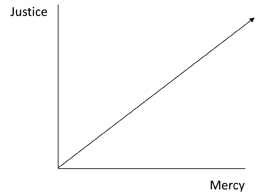
When I focused on God’s law as the primary revelation of his will, justice and mercy seemed like oppositional concepts.  Justice meant the uniform application of law (punishment mainly) and mercy was an exception to that uniform application.  As justice increased mercy decreased.  As mercy increased justice decreased (Fig. 1).

Slide 1

Fig. 1

Justice served as a limit on mercy as mercy limited justice.  So the righteousness of justice and mercy was a mean between these extremes, because justice was by definition unmerciful, at least in part, and mercy was by definition unjust, at least in part.  This made perfect sense to my religious mind, until I read the Bible.

Woe to you, experts in the law and you Pharisees, hypocrites, Jesus said.  You give a tenth of mint, dill, and cumin, yet you neglect what is more important in the law – justice (κρίσιν, a form of κρίσις), mercy1 (ἔλεος), and faithfulness (πίστιν, a form of πίστις)!  You should have done these things without neglecting the others.2  Love was added to this list in Luke’s Gospel account: But3 woe to you Pharisees!  You give a tenth of your mint, rue, and every herb, yet4 you neglect5 justice (κρίσιν) and love (ἀγάπην, a form of ἀγάπη) for God!6

How could mercy be both an exception to the uniform application of law and, along with justice and faithfulness, more important in the law than tithing mint, dill and cumin?  Jesus, it seemed, considered mercy part of the justice of the law rather than a limit upon it.  Go and learn what this saying means, He said, quoting Hosea, “I want mercy (ἔλεος) and not sacrifice.”  For I did not come to call the righteous, but sinners.7

#

Jesus (NET)

Blue Letter Bible (Septuagint)

NET Bible (Greek parallel text)

1

I want mercy and not sacrifice

Matthew 9:13 (NET)

ἔλεος θέλω καὶ οὐ θυσίαν

Hosea 6:6 Table

ἔλεος θέλω καὶ οὐ θυσίαν

Matthew 9:13

Why does your teacher eat with tax collectors and sinners?8 the Pharisees had asked, revealing their concern over the possibility of defilement.9  When Jesus heard this he said, “Those who are healthy don’t need a physician, but those who are sick do,”10 revealing his concern for the mercy that was an important part of the law.  On another occasion Jesus went even further and told the Pharisees, If you had known what this means: I want mercy (ἔλεος) and not sacrifice,” you would not have condemned the innocent.11  Jesus’ disciples had been gathering grain and eating the grain they had gathered on the Sabbath day.  It was about as direct a violation12 of the law of the Sabbath as I can imagine, but Jesus declared them innocent, adding that the Pharisees and I would agree with Him if we understood the mercy that was an important part of the law.

Teacher, what must I do to inherit eternal life?13 an expert in religious law asked Jesus (Luke 10:26-28 NET).

He said to him, “What is written in the law?  How do you understand it?”  The expert answered, Love (ἀγαπήσεις, a form of ἀγαπάω) the Lord your God with all your heart, with all your soul, with all your strength, and with all your mind, and love your neighbor as yourself.”  Jesus said to him, “You have answered correctly; do this, and you will live.”

The law expert asked for clarification of the term neighbor.  Jesus told a story:  A man…fell into the hands of robbers, who stripped him, beat him up, and went off, leaving him half dead.14  Two other men passed the robbers’ victim by, but one man felt compassion for him.  He went up to him and bandaged his wounds, pouring oil and wine on them.  Then he put him on his own animal, brought him to an inn, and took care of him.  The next day.15 he took out two silver coins and gave them to the innkeeper, saying,16 “Take care of him, and whatever else you spend, I will repay you when I come back this way.”17

Jesus asked, “Which18 of these three do you think became a neighbor to the man who fell into the hands of the robbers?”  The expert in religious law said, “The one who showed mercy (ἔλεος) to him.”  So19 Jesus said to him, “Go and do the same.”20  So mercy shown to a stranger defined the term neighbor, and became the justice of the law of loving God and one’s neighbor.  Beyond that this was the Gospel message in answer to the question, what must I do to inherit eternal life?  Clearly my religious mind was in error.

When Matthew quoted Isaiah his primary focus was on Jesus’ fulfillment of the part of the prophecy that read, He will not quarrel or cry out, nor will anyone hear his voice in the streets.21  Though, Great crowds followed [Jesus], and he healed them all…he sternly warned them not to make him known.22  I am more interested here in the rest of the prophecy: Here is my servant whom I have chosen, the one I love, in whom I take great delight.  I will put my Spirit on him, and he will proclaim justice (κρίσιν) to the nations.23  He will not break a bruised reed or extinguish a smoldering wick, until he brings justice (κρίσιν) to victory.24  As I began to recognize Jesus as the primary revelation of God’s will my understanding of justice and mercy began to change.

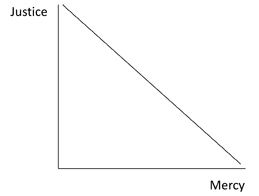
Justice and mercy are not in opposition but joined like a category I could only call justice-mercy (Fig. 2).

Slide 2

Fig. 2

Though justice-mercy may not actually be infinite in its capacity to increase, it is virtually infinite relative to my naive understanding.  Probably it should be thought of as justice-mercy-faithfulness-love.  But I’m not clever enough to represent that concept graphically.


Addendum (6/24/2015): Jim Searcy has published that the Septuagint is a hoax written by Origen and Eusebius 200 hundred years after Christ.  “In fact, the Septuagint ‘quotes’ from the New Testament and not vice versa…”  His contention is that the “King James Version is the infallible Word of God.”  So, I’ll re-examine the quotations above with the KJV.

#

Jesus (KJV)

KJV

NET Bible (Greek parallel text)

1

I will have mercy, and not sacrifice

Matthew 9:13 (KJV)

I desired mercy, and not sacrifice

Hosea 6:6

ἔλεος θέλω καὶ οὐ θυσίαν

Matthew 9:13

The KJV will have and desired, though different tenses, are admittedly closer than the NET: For I delight in faithfulness, not simply in sacrifice (Hosea 6:6a NET) and, I want mercy and not sacrifice (Matthew 9:13 NET).  If the present tense delight is incorrect relative to the past tense desired in Hebrew, this could be the first evidence I’ve discovered that the Septuagint quoted the New Testament.

The ASV, NKJV and NIV have desire (present), the DNT has delight (present), the GWT and TEV have want (present), TSMG am after (present), and YLT desired (past).  Young’s Literal Translation (YLT) carries some weight with me, but I don’t know any Hebrew to decide this for myself.


Addendum: July 9, 2025
According to a note (93) in the NET the expert in religious law quoted from Deuteronomy 6:5 in Luke 10:27. The following table compares the Greek of that quotation with that of the Septuagint.

Luke 10:27b (NET Parallel Greek)

Deuteronomy 6:5 (Septuagint BLB) Table

Deuteronomy 6:5 (Septuagint Elpenor)

ἀγαπήσεις κύριον τὸν θεόν σου ἐξ ὅλης [τῆς] καρδίας σου καὶ ἐν ὅλῃ τῇ ψυχῇ σου καὶ ἐν ὅλῃ τῇ ἰσχύϊ σου καὶ ἐν ὅλῃ τῇ διανοίᾳ σου καὶ ἀγαπήσεις κύριον τὸν θεόν σου ἐξ ὅλης τῆς καρδίας σου καὶ ἐξ ὅλης τῆς ψυχῆς σου καὶ ἐξ ὅλης τῆς δυνάμεώς σου καὶ ἀγαπήσεις Κύριον τὸν Θεόν σου ἐξ ὅλης τῆς καρδίας σου καὶ ἐξ ὅλης τῆς ψυχῆς σου καὶ ἐξ ὅλης τῆς δυνάμεώς σου

Luke 10:27b (NET)

Deuteronomy 6:5 (NETS)

Deuteronomy 6:5 (English Elpenor)

Love the Lord your God with all your heart, with all your soul, with all your strength, and with all your mind, And you shall love the Lord your God with the whole of your mind and with the whole of your soul and with the whole of your power. And thou shalt love the Lord thy God with all thy mind, and with all thy soul, and all thy strength.

According to a note (94) in the NET the expert in religious law quoted from Leviticus 19:18 in Luke 10:27. The following table compares the Greek of that quotation with that of the Septuagint.

Luke 10:27c (NET Parallel Greek)

Leviticus 19:18b (Septuagint BLB) Table

Leviticus 19:18b (Septuagint Elpenor)

τὸν πλησίον σου ὡς σεαυτόν ἀγαπήσεις τὸν πλησίον σου ὡς σεαυτόν ἀγαπήσεις τὸν πλησίον σου ὡς σεαυτόν

Luke 10:27c (NET)

Leviticus 19:18b (NETS)

Leviticus 19:18b (English Elpenor)

love your neighbor as yourself you shall love your neighbor as yourself thou shalt love thy neighbour as thyself

According to a note (28) in the NET Matthew quoted from Isaiah 42:1-4 in Matthew 12:18-21. The following table compares the Greek of Matthew 12:19 with that of Isaiah 42:2 in the Septuagint.

Matthew 12:19 (NET Parallel Greek)

Isaiah 42:2 (Septuagint BLB)

Isaiah 42:2 (Septuagint Elpenor)

οὐκ ἐρίσει οὐδὲ κραυγάσει, οὐδὲ ἀκούσει τις ἐν ταῖς πλατείαις τὴν φωνὴν αὐτοῦ οὐ κεκράξεται οὐδὲ ἀνήσει οὐδὲ ἀκουσθήσεται ἔξω φωνὴ αὐτοῦ οὐ κεκράξεται οὐδὲ ἀνήσει, οὐδὲ ἀκουσθήσεται ἔξω φωνὴ αὐτοῦ

Matthew 12:19 (NET)

Isaiah 42:2 (NETS)

Isaiah 42:2 (English Elpenor)

He will not quarrel or cry out, nor will anyone hear his voice in the streets. He will not cry out or send forth his voice, nor will his voice be heard outside; He shall not cry, nor lift up [his voice], nor shall his voice be heard without.

Matthew seems to have made his own translation from Hebrew.

According to a note (28) in the NET Matthew quoted from Isaiah 42:1-4 in Matthew 12:18-21. The following table compares the Greek of Matthew 12:18 with that of Isaiah 42:1 in the Septuagint.

Matthew 12:18 (NET Parallel Greek)

Isaiah 42:1 (Septuagint BLB)

Isaiah 42:1 (Septuagint Elpenor)

ἰδοὺ ὁ παῖς μου ὃν ᾑρέτισα, ἀγαπητός μου |εἰς| ὃν εὐδόκησεν ἡ ψυχή μου· θήσω τὸ πνεῦμα μου ἐπ᾿ αὐτόν, καὶ κρίσιν τοῖς ἔθνεσιν ἀπαγγελεῖ Ιακωβ ὁ παῖς μου ἀντιλήμψομαι αὐτοῦ Ισραηλ ἐκλεκτός μου προσεδέξατο αὐτὸν ἡ ψυχή μου ἔδωκα τὸ πνεῦμά μου ἐπ᾽ αὐτόν κρίσιν τοῖς ἔθνεσιν ἐξοίσει ΙΑΚΩΒ ὁ παῖς μου, ἀντιλήψομαι αὐτοῦ ᾿Ισραὴλ ἐκλεκτός μου, προσεδέξατο αὐτὸν ἡ ψυχή μου· ἔδωκα τὸ πνεῦμά μου ἐπ᾿ αὐτόν, κρίσιν τοῖς ἔθνεσιν ἐξοίσει

Matthew 12:18 (NET)

Isaiah 42:1 (NETS)

Isaiah 42:1 (English Elpenor)

“Here is my servant whom I have chosen, the one I love, in whom I take great delight. I will put my Spirit on him, and he will proclaim justice to the nations. Iakob is my servant; I will lay hold of him; Israel is my chosen; my soul has accepted him; he will bring forth judgment to the nations. Jacob is my servant, I will help him: Israel is my chosen, my soul has accepted him; I have put my Spirit upon him; he shall bring forth judgment to the Gentiles.

Here again, it seems that Matthew did some of his own translation from Hebrew.

According to a note (28) in the NET Matthew quoted from Isaiah 42:1-4 in Matthew 12:18-21. The following table compares the Greek Matthew 12:20 with that of Isaiah 42:3 in the Septuagint.

Matthew 12:20 (NET Parallel Greek)

Isaiah 42:3 (Septuagint BLB)

Isaiah 42:1 (Septuagint Elpenor)

κάλαμον συντετριμμένον οὐ κατεάξει καὶ λίνον τυφόμενον οὐ σβέσει, ἕως ἂν ἐκβάλῃ εἰς νῖκος τὴν κρίσιν κάλαμον τεθλασμένον οὐ συντρίψει καὶ λίνον καπνιζόμενον οὐ σβέσει ἀλλὰ εἰς ἀλήθειαν ἐξοίσει κρίσιν κάλαμον τεθλασμένον οὐ συντρίψει καὶ λίνον καπνιζόμενον οὐ σβέσει, ἀλλὰ εἰς ἀλήθειαν ἐξοίσει κρίσιν

Matthew 12:20 (NET)

Isaiah 42:1 (NETS)

Isaiah 42:1 (English Elpenor)

He will not break a bruised reed or extinguish a smoldering wick, until he brings justice to victory. A bruised reed shall he not break, and the smoking flax shall he not quench: he shall bring forth judgment unto truth. A bruised reed shall he not break, and smoking flax shall he not quench; but he shall bring forth judgment to truth.

Matthew’s and the Holy Spirit’s word choices deserve a fuller consideration than I am giving them here.

Tables comparing Exodus 16:4; 16:5; Isaiah 42:2; 42:1 and 42:3 in the Tanakh, KJV and NET, and comparing the Greek of Exodus 16:4; 16:5; Isaiah 42:2; 42:1 and 42:3 in the Septuagint (BLB and Elpenor), and tables comparing Matthew 23:23; Luke 11:42; 10:25; 10:30; 10:33 and 10:35-37 in the KJV and NET follow.

Exodus 16:4 (Tanakh)

Exodus 16:4 (KJV)

Exodus 16:4 (NET)

Then said HaShem unto Moses: ‘Behold, I will cause to rain bread from heaven for you; and the people shall go out and gather a day’s portion every day, that I may prove them, whether they will walk in My law, or not. Then said the LORD unto Moses, Behold, I will rain bread from heaven for you; and the people shall go out and gather a certain rate every day, that I may prove them, whether they will walk in my law, or no. Then the Lord said to Moses, “I am going to rain bread from heaven for you, and the people will go out and gather the amount for each day, so that I may test them. Will they walk in my law or not?

Exodus 16:4 (Septuagint BLB)

Exodus 16:4 (Septuagint Elpenor)

εἶπεν δὲ κύριος πρὸς Μωυσῆν ἰδοὺ ἐγὼ ὕω ὑμῖν ἄρτους ἐκ τοῦ οὐρανοῦ καὶ ἐξελεύσεται ὁ λαὸς καὶ συλλέξουσιν τὸ τῆς ἡμέρας εἰς ἡμέραν ὅπως πειράσω αὐτοὺς εἰ πορεύσονται τῷ νόμῳ μου ἢ οὔ εἶπε δὲ Κύριος πρὸς Μωυσῆν· ἰδοὺ ἐγὼ ὕω ὑμῖν ἄρτους ἐκ τοῦ οὐρανοῦ, καὶ ἐξελεύσεται ὁ λαὸς καὶ συλλέξουσι τὸ τῆς ἡμέρας εἰς ἡμέραν, ὅπως πειράσω αὐτούς, εἰ πορεύσονται τῷ νόμῳ μου ἢ οὔ

Exodus 16:4 (NETS)

Exodus 16:4 (English Elpenor)

Then the Lord said to Moyses, “Look, I am going to rain bread from heaven for you, and the people shall go out, and they shall collect the day’s portion for a day so that I might test them whether they will walk by my law or not. And the Lord said to Moses, Behold, I [will] rain bread upon you out of heaven: and the people shall go forth, and they shall gather their daily portion for the day, that I may try them whether they will walk in my law or not.

Exodus 16:5 (Tanakh)

Exodus 16:5 (KJV)

Exodus 16:5 (NET)

And it shall come to pass on the sixth day that they shall prepare that which they bring in, and it shall be twice as much as they gather daily.’ And it shall come to pass, that on the sixth day they shall prepare that which they bring in; and it shall be twice as much as they gather daily. On the sixth day they will prepare what they bring in, and it will be twice as much as they gather every other day.”

Exodus 16:5 (Septuagint BLB)

Exodus 16:5 (Septuagint Elpenor)

καὶ ἔσται τῇ ἡμέρᾳ τῇ ἕκτῃ καὶ ἑτοιμάσουσιν ὃ ἐὰν εἰσενέγκωσιν καὶ ἔσται διπλοῦν ὃ ἐὰν συναγάγωσιν τὸ καθ᾽ ἡμέραν εἰς ἡμέραν καὶ ἔσται ἐν τῇ ἡμέρᾳ τῇ ἕκτῃ καὶ ἑτοιμάσουσιν ὃ ἂν εἰσενέγκωσι, καὶ ἔσται διπλοῦν ὃ ἐὰν συναγάγωσι τὸ καθ᾿ ἡμέραν εἰς ἡμέραν

Exodus 16:5 (NETS)

Exodus 16:5 (English Elpenor)

And it shall be on the sixth day, and they shall prepare whatever they bring in, and it shall be double whatever they gather daily for a day.” And it shall come to pass on the sixth day that they shall prepare whatsoever they have brought in, and it shall be double of what they shall have gathered for the day, daily.

Isaiah 42:2 (Tanakh)

Isaiah 42:2 (KJV)

Isaiah 42:2 (NET)

He shall not cry, nor lift up, nor cause his voice to be heard in the street. He shall not cry, nor lift up, nor cause his voice to be heard in the street. He will not cry out or shout; he will not publicize himself in the streets.

Isaiah 42:2 (Septuagint BLB)

Isaiah 42:2 (Septuagint Elpenor)

οὐ κεκράξεται οὐδὲ ἀνήσει οὐδὲ ἀκουσθήσεται ἔξω ἡ φωνὴ αὐτοῦ οὐ κεκράξεται οὐδὲ ἀνήσει, οὐδὲ ἀκουσθήσεται ἔξω ἡ φωνὴ αὐτοῦ

Isaiah 42:2 (NETS)

Isaiah 42:2 (English Elpenor)

He will not cry out or send forth his voice, nor will his voice be heard outside; He shall not cry, nor lift up [his voice], nor shall his voice be heard without.

Isaiah 42:1 (Tanakh)

Isaiah 42:1 (KJV)

Isaiah 42:1 (NET)

Behold my servant, whom I uphold; mine elect, in whom my soul delighteth; I have put my spirit upon him: he shall bring forth judgment to the Gentiles. Behold my servant, whom I uphold; mine elect, in whom my soul delighteth; I have put my spirit upon him: he shall bring forth judgment to the Gentiles. “Here is my servant whom I support, my chosen one in whom I take pleasure. I have placed my Spirit on him; he will make just decrees for the nations.

Isaiah 42:1 (Septuagint BLB)

Isaiah 42:1 (Septuagint Elpenor)

Ιακωβ ὁ παῖς μου ἀντιλήμψομαι αὐτοῦ Ισραηλ ὁ ἐκλεκτός μου προσεδέξατο αὐτὸν ἡ ψυχή μου ἔδωκα τὸ πνεῦμά μου ἐπ᾽ αὐτόν κρίσιν τοῖς ἔθνεσιν ἐξοίσει ΙΑΚΩΒ ὁ παῖς μου, ἀντιλήψομαι αὐτοῦ· ᾿Ισραὴλ ὁ ἐκλεκτός μου, προσεδέξατο αὐτὸν ἡ ψυχή μου· ἔδωκα τὸ πνεῦμά μου ἐπ᾿ αὐτόν, κρίσιν τοῖς ἔθνεσιν ἐξοίσει

Isaiah 42:1 (NETS)

Isaiah 42:1 (English Elpenor)

Iakob is my servant; I will lay hold of him; Israel is my chosen; my soul has accepted him; I will put my spirit upon him; he will bring forth judgment to the nations. Jacob is my servant, I will help him: Israel is my chosen, my soul has accepted him; I have put my Spirit upon him; he shall bring forth judgment to the Gentiles.

Isaiah 42:3 (Tanakh)

Isaiah 42:3 (KJV)

Isaiah 42:3 (NET)

A bruised reed shall he not break, and the smoking flax shall he not quench: he shall bring forth judgment unto truth. A bruised reed shall he not break, and the smoking flax shall he not quench: he shall bring forth judgment unto truth. A crushed reed he will not break, a dim wick he will not extinguish; he will faithfully make just decrees.

Isaiah 42:3 (Septuagint BLB)

Isaiah 42:3 (Septuagint Elpenor)

κάλαμον τεθλασμένον οὐ συντρίψει καὶ λίνον καπνιζόμενον οὐ σβέσει ἀλλὰ εἰς ἀλήθειαν ἐξοίσει κρίσιν κάλαμον τεθλασμένον οὐ συντρίψει καὶ λίνον καπνιζόμενον οὐ σβέσει, ἀλλὰ εἰς ἀλήθειαν ἐξοίσει κρίσιν

Isaiah 42:3 (NETS)

Isaiah 42:3 (English Elpenor)

a bruised reed he will not break, and a smoking wick he will not quench, but he will bring forth judgment for truth. A bruised reed shall he not break, and smoking flax shall he not quench; but he shall bring forth judgment to truth.

Matthew 23:23 (NET)

Matthew 23:23 (KJV)

“Woe to you, experts in the law and you Pharisees, hypocrites! You give a tenth of mint, dill, and cumin, yet you neglect what is more important in the law—justice, mercy, and faithfulness! You should have done these things without neglecting the others. Woe unto you, scribes and Pharisees, hypocrites! for ye pay tithe of mint and anise and cummin, and have omitted the weightier matters of the law, judgment, mercy, and faith: these ought ye to have done, and not to leave the other undone.

Matthew 23:23 (NET Parallel Greek)

Matthew 23:23 (Stephanus Textus Receptus)

Matthew 23:23 (Byzantine Majority Text)

Οὐαὶ ὑμῖν, γραμματεῖς καὶ Φαρισαῖοι ὑποκριταί, ὅτι ἀποδεκατοῦτε τὸ ἡδύοσμον καὶ τὸ ἄνηθον καὶ τὸ κύμινον καὶ ἀφήκατε τὰ βαρύτερα τοῦ νόμου, τὴν κρίσιν καὶ τὸ ἔλεος καὶ τὴν πίστιν· ταῦτα ἔδει ποιῆσαι κακεῖνα μὴ |ἀφιέναι| ουαι υμιν γραμματεις και φαρισαιοι υποκριται οτι αποδεκατουτε το ηδυοσμον και το ανηθον και το κυμινον και αφηκατε τα βαρυτερα του νομου την κρισιν και τον ελεον και την πιστιν ταυτα εδει ποιησαι κακεινα μη αφιεναι ουαι υμιν γραμματεις και φαρισαιοι υποκριται οτι αποδεκατουτε το ηδυοσμον και το ανηθον και το κυμινον και αφηκατε τα βαρυτερα του νομου την κρισιν και τον ελεον και την πιστιν ταυτα εδει ποιησαι κακεινα μη αφιεναι

Luke 11:42 (NET)

Luke 11:42 (KJV)

“But woe to you Pharisees! You give a tenth of your mint, rue, and every herb, yet you neglect justice and love for God! But you should have done these things without neglecting the others. But woe unto you, Pharisees! for ye tithe mint and rue and all manner of herbs, and pass over judgment and the love of God: these ought ye to have done, and not to leave the other undone.

Luke 11:42 (NET Parallel Greek)

Luke 11:42 (Stephanus Textus Receptus)

Luke 11:42 (Byzantine Majority Text)

ἀλλὰ οὐαὶ ὑμῖν τοῖς Φαρισαίοις, ὅτι ἀποδεκατοῦτε τὸ ἡδύοσμον καὶ τὸ πήγανον καὶ πᾶν λάχανον καὶ παρέρχεσθε τὴν κρίσιν καὶ τὴν ἀγάπην τοῦ θεοῦ· ταῦτα δὲ ἔδει ποιῆσαι κακεῖνα μὴ παρεῖναι αλλ ουαι υμιν τοις φαρισαιοις οτι αποδεκατουτε το ηδυοσμον και το πηγανον και παν λαχανον και παρερχεσθε την κρισιν και την αγαπην του θεου ταυτα εδει ποιησαι κακεινα μη αφιεναι αλλ ουαι υμιν τοις φαρισαιοις οτι αποδεκατουτε το ηδυοσμον και το πηγανον και παν λαχανον και παρερχεσθε την κρισιν και την αγαπην του θεου ταυτα εδει ποιησαι κακεινα μη αφιεναι

Luke 10:25 (NET)

Luke 10:25 (KJV)

Now an expert in religious law stood up to test Jesus, saying, “Teacher, what must I do to inherit eternal life?” And, behold, a certain lawyer stood up, and tempted him, saying, Master, what shall I do to inherit eternal life?

Luke 10:25 (NET Parallel Greek)

Luke 10:25 (Stephanus Textus Receptus)

Luke 10:25 (Byzantine Majority Text)

Καὶ ἰδοὺ νομικός τις ἀνέστη ἐκπειράζων αὐτὸν λέγων· διδάσκαλε, τί ποιήσας ζωὴν αἰώνιον κληρονομήσω και ιδου νομικος τις ανεστη εκπειραζων αυτον και λεγων διδασκαλε τι ποιησας ζωην αιωνιον κληρονομησω και ιδου νομικος τις ανεστη εκπειραζων αυτον και λεγων διδασκαλε τι ποιησας ζωην αιωνιον κληρονομησω

Luke 10:30 (NET)

Luke 10:30 (KJV)

Jesus replied, “A man was going down from Jerusalem to Jericho, and fell into the hands of robbers, who stripped him, beat him up, and went off, leaving him half dead. And Jesus answering said, A certain man went down from Jerusalem to Jericho, and fell among thieves, which stripped him of his raiment, and wounded him, and departed, leaving him half dead.

Luke 10:30 (NET Parallel Greek)

Luke 10:30 (Stephanus Textus Receptus)

Luke 10:30 (Byzantine Majority Text)

῾Υπολαβὼν ὁ Ἰησοῦς εἶπεν· ἄνθρωπος τις κατέβαινεν ἀπὸ Ἰερουσαλὴμ εἰς Ἰεριχὼ καὶ λῃσταῖς περιέπεσεν, οἳ καὶ ἐκδύσαντες αὐτὸν καὶ πληγὰς ἐπιθέντες ἀπῆλθον ἀφέντες ἡμιθανῆ υπολαβων δε ο ιησους ειπεν ανθρωπος τις κατεβαινεν απο ιερουσαλημ εις ιεριχω και λησταις περιεπεσεν οι και εκδυσαντες αυτον και πληγας επιθεντες απηλθον αφεντες ημιθανη τυγχανοντα υπολαβων δε ο ιησους ειπεν ανθρωπος τις κατεβαινεν απο ιερουσαλημ εις ιεριχω και λησταις περιεπεσεν οι και εκδυσαντες αυτον και πληγας επιθεντες απηλθον αφεντες ημιθανη τυγχανοντα

Luke 10:33 (NET)

Luke 10:33 (KJV)

But a Samaritan who was traveling came to where the injured man was, and when he saw him, he felt compassion for him. But a certain Samaritan, as he journeyed, came where he was: and when he saw him, he had compassion on him,

Luke 10:33 (NET Parallel Greek)

Luke 10:33 (Stephanus Textus Receptus)

Luke 10:33 (Byzantine Majority Text)

Σαμαρίτης δέ τις ὁδεύων ἦλθεν κατ᾿ αὐτὸν καὶ ἰδὼν ἐσπλαγχνίσθη σαμαρειτης δε τις οδευων ηλθεν κατ αυτον και ιδων αυτον εσπλαγχνισθη σαμαρειτης δε τις οδευων ηλθεν κατ αυτον και ιδων αυτον εσπλαγχνισθη

Luke 10:35-37 (NET)

Luke 10:35-37 (KJV)

The next day he took out two silver coins and gave them to the innkeeper, saying, ‘Take care of him, and whatever else you spend, I will repay you when I come back this way.’ And on the morrow when he departed, he took out two pence, and gave them to the host, and said unto him, Take care of him; and whatsoever thou spendest more, when I come again, I will repay thee.

Luke 10:35 (NET Parallel Greek)

Luke 10:35 (Stephanus Textus Receptus)

Luke 10:35 (Byzantine Majority Text)

καὶ ἐπὶ τὴν αὔριον ἐκβαλὼν ἔδωκεν |δύο δηνάρια| τῷ πανδοχεῖ καὶ εἶπεν· ἐπιμελήθητι αὐτοῦ, καὶ ὅ τι ἂν προσδαπανήσῃς ἐγὼ ἐν τῷ ἐπανέρχεσθαι με ἀποδώσω σοι και επι την αυριον εξελθων εκβαλων δυο δηναρια εδωκεν τω πανδοχει και ειπεν αυτω επιμεληθητι αυτου και ο τι αν προσδαπανησης εγω εν τω επανερχεσθαι με αποδωσω σοι και επι την αυριον εξελθων εκβαλων δυο δηναρια εδωκεν τω πανδοχει και ειπεν αυτω επιμεληθητι αυτου και ο τι αν προσδαπανησης εγω εν τω επανερχεσθαι με αποδωσω σοι
Which of these three do you think became a neighbor to the man who fell into the hands of the robbers?” Which now of these three, thinkest thou, was neighbour unto him that fell among the thieves?

Luke 10:36 (NET Parallel Greek)

Luke 10:36 (Stephanus Textus Receptus)

Luke 10:36 (Byzantine Majority Text)

τίς τούτων τῶν τριῶν πλησίον δοκεῖ σοι γεγονέναι τοῦ ἐμπεσόντος εἰς τοὺς λῃστάς τις ουν τουτων των τριων δοκει σοι πλησιον γεγονεναι του εμπεσοντος εις τους ληστας τις ουν τουτων των τριων πλησιον δοκει σοι γεγονεναι του εμπεσοντος εις τους ληστας
The expert in religious law said, “The one who showed mercy to him.” So Jesus said to him, “Go and do the same.” And he said, He that shewed mercy on him. Then said Jesus unto him, Go, and do thou likewise.

Luke 10:37 (NET Parallel Greek)

Luke 10:37 (Stephanus Textus Receptus)

Luke 10:37 (Byzantine Majority Text)

ὁ δὲ εἶπεν· ὁ ποιήσας τὸ ἔλεος μετ᾿ αὐτοῦ. εἶπεν δὲ αὐτῷ |ὁ| Ἰησοῦς· πορεύου καὶ σὺ ποίει ὁμοίως ο δε ειπεν ο ποιησας το ελεος μετ αυτου ειπεν ουν αυτω ο ιησους πορευου και συ ποιει ομοιως ο δε ειπεν ο ποιησας το ελεος μετ αυτου ειπεν ουν αυτω ο ιησους πορευου και συ ποιει ομοιως

2 Matthew 23:23 (NET)

4 The NET parallel Greek text and NA28 had the conjunction δὲ here. The Stephanus Textus Receptus and Byzantine Majority Text did not.

5 The NET parallel Greek text and NA28 had παρεῖναι here, an infinitive form of πάρειμι, where the Stephanus Textus Receptus and Byzantine Majority Text had αφιεναι (KJV: to leave…undone), an infinitive form of ἀφίημι.

6 Luke 11:42 (NET)

7 Matthew 9:13 (NET) Table

8 Matthew 9:11 (NET) Table

10 Matthew 9:12 (NET) Table

11 Matthew 12:7 (NET) Table

12 Then the Lord said to Moses, “I am going to rain bread from heaven for you, and the people will go out and gather the amount for each day, so that I may test them.  Will they walk in my law or not?  On the sixth day they will prepare what they bring in, and it will be twice as much as they gather every other day.” (Exodus 16:4, 5 NET)

13 Luke 10:25 (NET)

14 Luke 10:30 (NET) The Stephanus Textus Receptus and Byzantine Majority Text had τυγχανοντα following half dead (not translated in the KJV), a participle of τυγχάνω. The NET parallel Greek Text and NA28 did not.

15 The Stephanus Textus Receptus and Byzantine Majority Text had εξελθων (KJV: when he departed) here, a participle of ἐξέρχομαι. The NET parallel Greek Text and NA28 did not.

16 The Stephanus Textus Receptus and Byzantine Majority Text had αυτω (KJV: unto him) here. The NET parallel Greek Text and NA28 did not.

17 Luke 10:33-35 (NET)

18 The Stephanus Textus Receptus and Byzantine Majority Text had ουν (KJV: now) following Which. The NET parallel Greek Text and NA28 did not.

19 The NET parallel Greek Text and NA28 had δὲ here, where the Stephanus Textus Receptus and Byzantine Majority Text had ουν (KJV: Then).

20 Luke 10:36, 37 (NET)

21 Matthew 12:19 (NET)

22 Matthew 12:15b, 16 (NET)

23 Matthew 12:18 (NET)

24 Matthew 12:20 (NET)